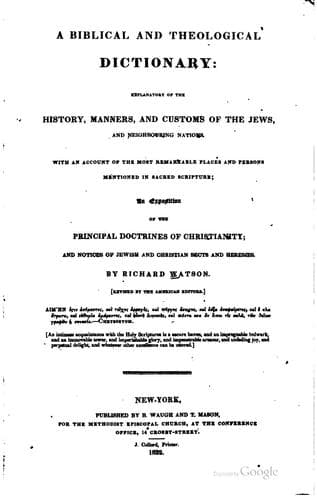
A Biblical and Theological Dictionary: explanatory of the history, manners, and customs of the Jews, and neighbouring nationsWatson, Richard
Religion
A Biblical and Theological Dictionary: explanatory of the history, manners, and customs of the Jews, and neighbouring nations
Watson, Richard
Bible -- Dictionaries; Theology -- Dictionaries
3. The intentional offering up Isaac, with its result, was probably that
transaction in which Abraham, more clearly than in any other, “saw the
day of Christ, and was glad.” He received Isaac from the dead, says St.
Paul, “in a figure.” This could be a figure of nothing but the
resurrection of our Lord; and, if so, Isaac’s being laid upon the altar
was a figure of his sacrificial death, scenically and most impressively
represented to Abraham. The _place_, the same ridge of hills on which
our Lord was crucified; the _person_, an only son, to die for no offence
of his own; the _sacrificer_, a father; the _receiving back_, as it
were, from death to life; the _name_ impressed upon the place,
importing, “_the Lord will provide_,” in allusion to Abraham’s own words
to Isaac, “the Lord will provide a lamb for a burnt offering;” all
indicate a mystery which lay deep beneath this transaction, and which
Abraham, as the reward of his obedience, was permitted to behold. “The
day” of Christ’s humiliation and exaltation was thus opened to him; and
served to keep the great truth in mind, that the true burnt offering and
sacrifice for sin was to be something higher than the immolation of
lambs and bulls and goats,--nay, something more than what was _merely_
human.
4. The transaction of the expulsion of Hagar was also a type. It was an
allegory in action, by which St. Paul teaches us to understand that the
son of the bondwoman represented those who are under the law; and the
child of the freewoman those who by faith in Christ are supernaturally
begotten into the family of God. The bondwoman and her son being cast
out, represented also the expulsion of the unbelieving Jews from the
church of God, which was to be composed of true believers of all
nations, all of whom, whether Jews or Gentiles, were to become “fellow
heirs.”
III. But Abraham appears before us invested with a MYSTIC character,
which it is of great importance rightly to understand.
Public-domain text, read in full here on John Shaqi.
Reviews
Reviews
No reviews yet
Be the first to share your thoughts on this work.
Join the Discussion
Join the discussion
Sign in to leave a comment or review.
Sign InorCreate an account