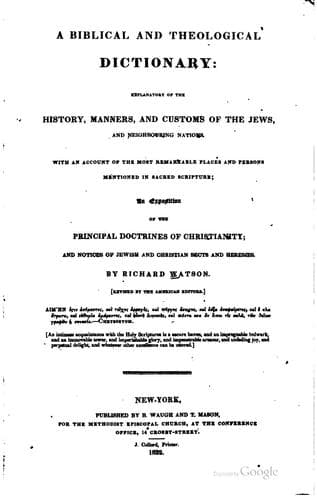
A Biblical and Theological Dictionary: explanatory of the history, manners, and customs of the Jews, and neighbouring nationsWatson, Richard
Religion
A Biblical and Theological Dictionary: explanatory of the history, manners, and customs of the Jews, and neighbouring nations
Watson, Richard
Bible -- Dictionaries; Theology -- Dictionaries
ABSOLUTION, in the church of Rome, is a sacrament, in which the priests
assume the power of forgiving sins. The rite of absolution in the church
of England is acknowledged to be declarative only--“Almighty God hath
given power and commandment to his ministers to declare and pronounce to
his people, being penitent, the absolution and remission of their sins:
He pardoneth,” &c. In this view it is innocent; and although any private
Christian has a right to declare and pronounce the same doctrine to his
neighbour, the _official_ publication of the grace of the Gospel is the
public duty of its ministers in the congregation, since they are
Christ’s “ambassadors.”
ABSTINENCE, forbearance of any thing It is generally used with reference
to forbearance from food under a religious motive. The Jewish law
ordained that the priests should abstain from the use of wine during the
whole time of their being employed in the service of the temple, Lev. x,
9. The same abstinence was enjoined upon the Nazarites, during the time
of their Nazariteship, or separation, Num. vi, 3. The Jews were
commanded to abstain from several sorts of animals. See ANIMAL.
The fat of all sorts of animals that were sacrificed was forbidden to be
eaten, Lev. iii, 17; vii, 23; and the blood of every animal, in general,
was prohibited under pain of death. Indeed blood was forbidden by the
Creator, from the time of the grant of the flesh of beasts to man for
food; this prohibition was continued under the Jewish economy, and
transmitted to the Christian church by Apostolic authority, Acts xv, 28,
29. (See _Blood_.) The Jews also abstained from the sinew which is upon
the hollow of the thigh, Gen. xxxii, 25; because of the shrinking of the
sinew of Jacob’s thigh when touched by the angel, as though by that the
part had been made sacred.
Among the primitive Christians, some denied themselves the use of such
meats as were prohibited by the law; others treated this abstinence with
contempt. St. Paul has given his decision on these questions in his
epistles, 1 Cor. viii, 7–10; Rom. xiv, 1–3. The council of Jerusalem,
which was held by the Apostles, enjoined the Christian converts to
abstain from meats strangled, from blood, from fornication, and from
idolatry, Acts xv, 20.
The spiritual monarchy of the western world introduced another sort of
abstinence which may be termed _ritual_, and which consists in
abstaining from particular meats at certain times and seasons, the rules
of which are called rogations. The ancient Lent was observed only a few
days before Easter. In the course of the third century, it extended at
Rome to three weeks; and before the middle of the succeeding age, it was
prolonged to six weeks, and began to be called quadragesima, or the
forty days’ fast.
Public-domain text, read in full here on John Shaqi.
Reviews
Reviews
No reviews yet
Be the first to share your thoughts on this work.
Join the Discussion
Join the discussion
Sign in to leave a comment or review.
Sign InorCreate an account