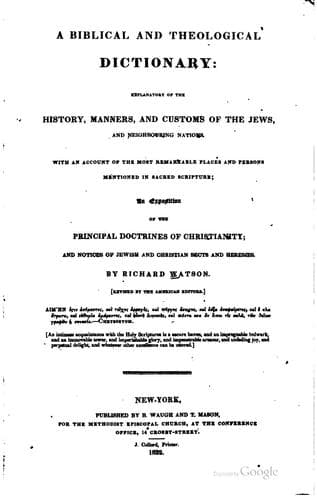
A Biblical and Theological Dictionary: explanatory of the history, manners, and customs of the Jews, and neighbouring nations — John Shaqi
A Biblical and Theological Dictionary: explanatory of the history, manners, and customs of the Jews, and neighbouring nationsWatson, Richard
Religion
A Biblical and Theological Dictionary: explanatory of the history, manners, and customs of the Jews, and neighbouring nations
Watson, Richard
Bible -- Dictionaries; Theology -- Dictionaries
4. The wide and deep impression made by the character of Abraham upon
the ancient world is proved by the reverence which people of almost all
nations and countries have paid to him, and the manner in which the
events of his life have been interwoven in their mythology, and their
religious traditions. Jews, Magians, Sabians, Indians, and Mohammedans
have claimed him as the great patriarch and founder of their several
sects; and his history has been embellished with a variety of fictions.
One of the most pleasing of these is the following, but it proceeds upon
the supposition that he was educated in idolatry: “As Abraham was
walking by night from the grotto where he was born, to the city of
Babylon, he gazed on the stars of heaven, and among them on the
beautiful planet Venus. ‘Behold,’ said he within himself, ‘the God and
Lord of the universe!’ but the star set and disappeared, and Abraham
felt that the Lord of the universe could not thus be liable to change.
Shortly after, he beheld the moon at the full: ‘Lo,’ he cried, ‘the
Divine Creator, the manifest Deity!’ but the moon sank below the
horizon, and Abraham made the same reflection as at the setting of the
evening star. All the rest of the night he passed in profound
rumination; at sunrise he stood before the gates of Babylon, and saw the
whole people prostrate in adoration. ‘Wondrous orb,‘ he exclaimed, ‘thou
surely art the Creator and Ruler of all nature! but thou, too, hastest
like the rest to thy setting!--neither then art thou my Creator, my
Lord, or my God!’”
ABRAHAMITES, reported heretical sects of the eighth and ninth centuries,
charged with the Paulician errors, and some of them with idolatry. For
these charges we have, however, only the word of their persecutors. Also
the name of a sect in Bohemia, as late as 1782, who professed the
religion of Abraham before his circumcision, and admitted no scriptures
but the decalogue and the Lord’s prayer. As these were persecuted, they
too were probably misrepresented, and especially as their conduct is
allowed to have been good, even by their enemies.
ABSALOM, the son of David by Maachah, daughter of the king of Geshur;
distinguished for his fine person, his vices, and his unnatural
rebellion. Of his open revolt, his conduct in Jerusalem, his pursuit of
the king his father, his defeat and death, see 2 Sam. xvi-xviii, at
large.
Public-domain text, read in full here on John Shaqi.
Reviews
Reviews
No reviews yet
Be the first to share your thoughts on this work.
Join the Discussion
Join the discussion
Sign in to leave a comment or review.
Sign InorCreate an account