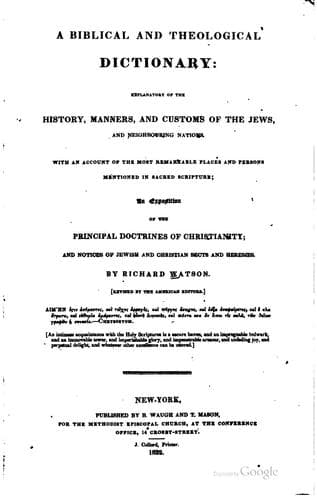
A Biblical and Theological Dictionary: explanatory of the history, manners, and customs of the Jews, and neighbouring nationsWatson, Richard
Religion
A Biblical and Theological Dictionary: explanatory of the history, manners, and customs of the Jews, and neighbouring nations
Watson, Richard
Bible -- Dictionaries; Theology -- Dictionaries
ABYSSINIAN CHURCH, a branch of the Coptic church, in Upper Ethiopia. The
Abyssinians, by the most authentic accounts, were converted to the
Christian faith about the year 330; when Frumentius, being
providentially raised to a high office, under the patronage of the queen
of Ethiopia, and ordained bishop of that country by Athanasius,
patriarch of Alexandria, established Christianity, built churches, and
ordained a regular clergy to officiate in them. The Abyssinian
Christians themselves, indeed, claim a much higher antiquity, having a
tradition, that the doctrine of Christ was first introduced among them
by Queen Candace, Acts viii, 27; or even preached there by the Apostles
Matthew and Bartholomew; but the former is supported by no collateral
evidence, and the latter is in opposition to high authority. Some of
them claim relation to the Israelites, through the queen of Sheba, so
far back as the reign of Solomon.
The Abyssinian Christians have always received their abuna, or
patriarch, from Alexandria, whence they sprang, and consequently their
creed is Monophysite, or Eutychian; maintaining one nature only in the
person of Christ, namely, the divine, in which they considered all the
properties of the humanity to be absorbed; in opposition to the
Nestorians.
On the power of the Saracens prevailing in the east, all communication
being nearly cut off between the eastern and western churches, the
Abyssinian church remained unknown in Europe till nearly the close of
the fifteenth century, when John II, of Portugal, accidentally hearing
of the existence of such a church, sent to make inquiry. This led to a
correspondence between the Abyssinians and the church of Rome; and
Bermudes, a Portuguese, was consecrated by the pope patriarch of
Ethiopia, and the Abyssinians were required to receive the Roman
Catholic faith, in return for some military assistance afforded to the
emperor. Instead of this, however, the emperor sent for a new patriarch
from Alexandria, imprisoned Bermudes, and declared the pope a heretic.
About the middle of the sixteenth century, the Jesuits attempted a
mission to Abyssinia, in the hope of reducing it to the pope’s
authority; but without success. In 1588 a second mission was attempted,
and so far succeeded as to introduce a system of persecution, which cost
many lives, and caused many troubles to the empire. In the following
century, however, the Jesuits were all expelled, Abyssinia returned to
its ancient faith, and nothing more was heard of the church of
Abyssinia, till the latter part of the last century.
After the expulsion of the Jesuits, all Europeans were interdicted; nor
does it appear that any one dared to attempt an entrance until the
celebrated Mr. Bruce, by the report of his medical skill, contrived to
introduce himself to the court, where he even obtained military
promotion; and was in such repute, that it was with great difficulty he
obtained leave to return to England.
Public-domain text, read in full here on John Shaqi.
Reviews
Reviews
No reviews yet
Be the first to share your thoughts on this work.
Join the Discussion
Join the discussion
Sign in to leave a comment or review.
Sign InorCreate an account