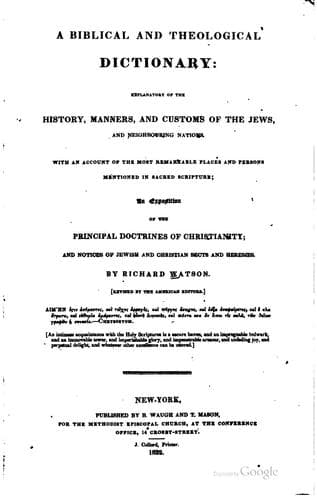
A Biblical and Theological Dictionary: explanatory of the history, manners, and customs of the Jews, and neighbouring nationsWatson, Richard
Religion
A Biblical and Theological Dictionary: explanatory of the history, manners, and customs of the Jews, and neighbouring nations
Watson, Richard
Bible -- Dictionaries; Theology -- Dictionaries
Encouraged, perhaps, by this circumstance, the Moravian brethren
attempted a mission to this country, but in vain. They were compelled to
retreat to Grand Cairo, from whence, by leave of the patriarch, they
visited the Copts at Behrusser, and formed a small society; but in 1783,
they were driven thence, and compelled to return to Europe. More
recently, however, the late king of Abyssinia (Itsa Takley Gorges)
addressed a letter to Mr. Salt, the British consul in Egypt, and
requested copies of some parts of both the Old and New Testaments.
Copies of the Psalms, in Ethiopic, as printed by the British and Foreign
Bible Society, were also sent to him.
ACADEMICS, a name given to such philosophers as adopted the doctrines of
Plato. They were so called from the _Academia_, a grove near Athens,
where they frequently indulged their contemplations. Academia is said to
derive its name from one Academus, a god or hero so called. Thus
Horace,--
_Atque inter sylvas Academi quærere verum._
[And in the groves of Academus to search for truth.]
The academics are divided into those of the first academy, who taught
the doctrines of Plato in their original purity; those of the second or
middle academy, who differed materially from the first, and inclined to
skepticism; and those of the new academy. The middle school laid it down
as a principle, that neither our senses, nor our reason, are to be
trusted; but that in common affairs we are to conform to received
opinions. The new academy maintained that we have no means of
distinguishing truth, and that the most evident appearances may lead us
into error; they granted the wise man opinion, but denied him certainty.
They held, however, that it was best to follow the greatest probability,
which was sufficient for all the useful purposes of life, and laid down
rules for the attainment of felicity. The difference betwixt the middle
academy and the new seems to have been this, that though they agreed in
the imbecility of human nature, yet the first denied that probabilities
were of any use in the pursuit of happiness; and the latter held them to
be of service in such a design: the former recommended a conformity with
received opinions, and the latter allowed men an opinion of their own.
In the first academy, Speusippus filled the chair; in the second,
Arcesilaus; and in the new or third academy, Carneades.
ACCAD, one of the four cities built by Nimrod, the founder of the
Assyrian empire. (See _Nimrod_.) “And the beginning of his kingdom was
Babel, and Erech, and Accad, and Calneh, in the land of Shinar,” Gen. x,
10. Thus it appears that Accad was contemporary with Babylon, and was
one of the first four great cities of the world.
Public-domain text, read in full here on John Shaqi.
Reviews
Reviews
No reviews yet
Be the first to share your thoughts on this work.
Join the Discussion
Join the discussion
Sign in to leave a comment or review.
Sign InorCreate an account