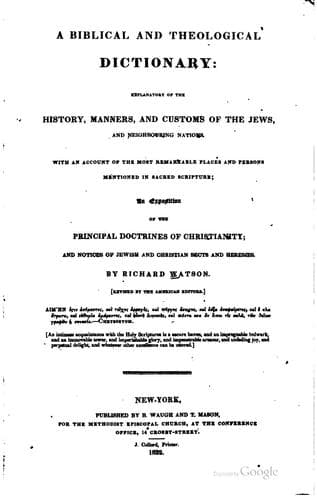
A Biblical and Theological Dictionary: explanatory of the history, manners, and customs of the Jews, and neighbouring nationsWatson, Richard
Religion
A Biblical and Theological Dictionary: explanatory of the history, manners, and customs of the Jews, and neighbouring nations
Watson, Richard
Bible -- Dictionaries; Theology -- Dictionaries
Aaron himself became also the object of jealousy; but two miraculous
interpositions confirmed him in his office of high priest, as of Divine
appointment. The first was the destruction of Korah, who sought that
office for himself, and of the two hundred and fifty Levites who
supported his pretensions, Num. xvi. The second was the blossoming of
Aaron’s rod, which was designed “to cause the murmurings of the
Israelites against him to cease,” by showing that he was chosen of God.
Moses having, at the command of God, taken twelve rods of an almond tree
from the princes of the twelve tribes, and Aaron’s separately, he placed
them in the tabernacle before the sanctuary, after having written upon
each the name of the tribe which it represented, and upon the rod of
Aaron the name of Aaron. The day following, when the rods were taken
out, that of Aaron “was budded, and brought forth buds, and bloomed
blossoms, and yielded almonds.” This rod therefore was laid up by the
ark, to perpetuate the remembrance of the miracle, and to be a token of
Aaron’s right to his office.
Aaron married Elisheba, the daughter of Amminadab, of the tribe of
Judah, by whom he had four sons, Nadab and Abihu, Eleazar and Ithamar,
Exodus vi, 23. The two first were killed by fire from heaven, as a
punishment for presuming to offer incense with strange fire in their
censers, Lev. x, 1, 2. From the two others the succession of high
priests was continued in Israel.
The account of the death of Aaron is peculiarly solemn and affecting. As
he and Moses, in striking the rock at Meribah, Num. xvi, had not
honoured God by a perfect obedience and faith, he in his wrath declared
unto them that they should not enter into the promised land. Soon after,
the Lord commanded Moses, “Take Aaron, and Eleazar his son, and bring
them up to mount Hor; and strip Aaron of his garments,”--his splendid
pontifical vestments,--“and put them upon Eleazar, his son; and Aaron
shall be gathered unto his people, and shall die there.” This command
was carried into effect in the presence of all Israel, who were encamped
at the foot of the mountain; and his son being invested with the
father’s priestly dress, Aaron died, and all the people mourned for him
thirty days. His sepulchre was left unmarked and unknown, perhaps to
prevent the superstitious reverence of future ages. In Deuteronomy it is
said that Aaron died at Mosera; because that was the name of the
district in which mount Hor was situated.
2. The PRIESTHOOD being established in Aaron and his family, the nature
of this office among the Israelites, and the distinction between the
high priest and the other priests, require here to be pointed out.
Public-domain text, read in full here on John Shaqi.
Reviews
Reviews
No reviews yet
Be the first to share your thoughts on this work.
Join the Discussion
Join the discussion
Sign in to leave a comment or review.
Sign InorCreate an account