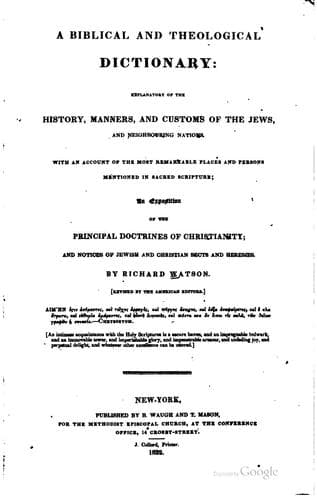
A Biblical and Theological Dictionary: explanatory of the history, manners, and customs of the Jews, and neighbouring nationsWatson, Richard
Religion
A Biblical and Theological Dictionary: explanatory of the history, manners, and customs of the Jews, and neighbouring nations
Watson, Richard
Bible -- Dictionaries; Theology -- Dictionaries
ADULLAM, a city in the tribe of Judah, to the west of Hebron, whose king
was slain by Joshua, Josh. xii, 15. It is frequently mentioned in the
history of Saul and David; and is chiefly memorable from the cave in its
neighbourhood, where David retired from Achish, king of Gath, when he
was joined by the distressed and discontented, to the number of four
hundred, over whom he became captain, 1 Sam. xxii, 1. Judas Maccabeus
encamped in the plain of Adullam, where he passed the Sabbath day, 2
Mac. xii, 38. Eusebius says that, in his time, Adullam was a very great
town, ten miles to the east of Eleutheropolis.
ADULTERY, the violation of the marriage bed. The law of Moses punished
with death both the man and the woman who were guilty of this crime,
Lev. xx, 10. If a woman was betrothed to a man, and was guilty of this
infamous crime before the marriage was completed, she was, in this case,
along with her paramour, to be stoned, Deut. xxii, 22–24.
When any man among the Jews, prompted by jealousy, suspected his wife of
the crime of adultery, he brought her first before the judges, and
informed them that, in consequence of his suspicions, he had privately
admonished her, but that she was regardless of his admonitions. If
before the judges she asserted her innocency, he required that she
should drink the _waters of jealousy_, that God might by these means
discover what she attempted to conceal, Num. v, 12, &c. The man then
produced his witnesses, and they were heard. After this, both the man
and the woman were conveyed to Jerusalem, and placed before the
sanhedrim; the judges of which, by threats and other means, endeavoured
to confound the woman, and make her confess. If she persisted in denying
the fact, she was led to the eastern gate of the court of Israel,
stripped of her own clothes, and dressed in black, before great numbers
of her own sex. The priest then told her, that if she was really
innocent, she had nothing to fear; but if guilty, she might expect to
suffer all that the law had denounced against her, to which she
answered, “Amen, amen.” The priest then wrote the terms of the law in
this form:--“If a strange man hath not come near you, and you are not
polluted by forsaking the bed of your husband, these bitter waters,
which I have cursed, will not hurt you: but if you have polluted
yourself by coming near to another man, and gone astray from your
husband,--may you be accursed of the Lord, and become an example for all
his people; may your thigh rot, and your belly swell till it burst; may
these cursed waters enter into your belly, and being swelled therewith,
may your thighs putrefy.“
Public-domain text, read in full here on John Shaqi.
Reviews
Reviews
No reviews yet
Be the first to share your thoughts on this work.
Elsewhere in the archive
Join the Discussion
Join the discussion
Sign in to leave a comment or review.
Sign InorCreate an account