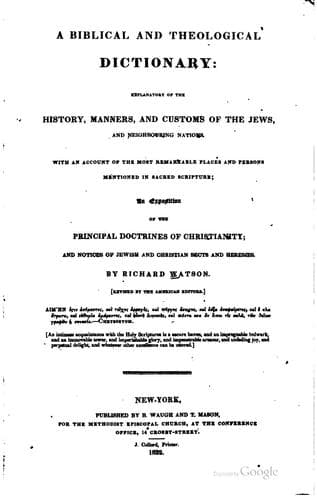
A Biblical and Theological Dictionary: explanatory of the history, manners, and customs of the Jews, and neighbouring nationsWatson, Richard
Religion
A Biblical and Theological Dictionary: explanatory of the history, manners, and customs of the Jews, and neighbouring nations
Watson, Richard
Bible -- Dictionaries; Theology -- Dictionaries
After this, the priest filled a pitcher out of the brazen vessel, near
the altar of burnt offerings, cast some dust of the pavement into it,
mingled something with it as bitter as wormwood, and then read the
curses, and received her answer of Amen. Another priest, in the
meantime, tore off her clothes as low as her bosom--made her head
bare--untied the tresses of her hair--fastened her clothes, which were
thus torn, with a girdle under her breasts, and then presented her with
the tenth part of an ephah, or about three pints, of barley meal. The
other priest then gave her the _waters of jealousy_, or bitterness, to
drink; and as soon as the woman had swallowed them, he gave her the meal
in a vessel like a frying-pan into her hand. This was stirred before the
Lord, and part of it thrown into the fire of the altar. If the wife was
innocent, she returned with her husband, and the waters, so far from
injuring her, increased her health, and made her more fruitful; but if
she was guilty, she grew pale immediately, her eyes swelled; and, lest
she should pollute the temple, she was instantly carried out, with these
symptoms upon her, and died instantly, with all the ignominious
circumstances related in the curses.
On this law of Moses, Michaëlis has the following remarks:--
“This oath was, perhaps, a relic of some more severe and barbarous
consuetudinary laws, whose rigours Moses mitigated; as he did in many
other cases, where an established usage could not be conveniently
abolished altogether. Among ourselves, in barbarous times, the _ordeal_,
or trial by fire, was, notwithstanding the parity of our married people,
in common use; and this, in point of equity, was much the same in
effect, as if the husband had had the right to insist on his wife
submitting to the hazardous trial of her purity, by drinking a poisoned
potion; which, according to an ancient superstition, could never hurt
her if she was innocent. And, in fact, such a right is not altogether
unexampled; for, according to Oldendorp’s _History of the Mission of the
Evangelical Brethren, in the Caribbee Islands_, it is actually in use
among some of the savage nations in the interior parts of Western
Africa.
“Now, when in place of a poisoned potion like this, which very few
husbands can be very willing to have administered to their wives, we
see, as among the Hebrews, an imprecation-drink, whose avenger God
himself promises to become, we cannot but be struck with the contrast of
wisdom and clemency which such a contrivance manifests. In the one case,
(and herein consists their great distinction,) innocence can only be
preserved by a miracle; while, on the other, guilt only is revealed and
punished by the hand of God himself.
Public-domain text, read in full here on John Shaqi.
Reviews
Reviews
No reviews yet
Be the first to share your thoughts on this work.
Elsewhere in the archive
Join the Discussion
Join the discussion
Sign in to leave a comment or review.
Sign InorCreate an account