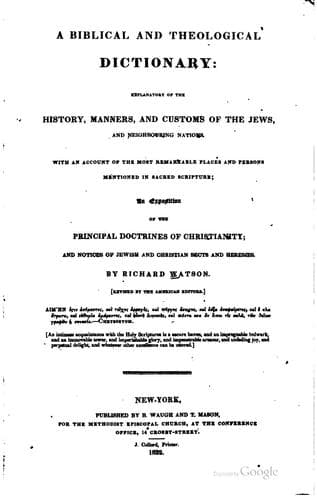
A Biblical and Theological Dictionary: explanatory of the history, manners, and customs of the Jews, and neighbouring nationsWatson, Richard
Religion
A Biblical and Theological Dictionary: explanatory of the history, manners, and customs of the Jews, and neighbouring nations
Watson, Richard
Bible -- Dictionaries; Theology -- Dictionaries
The period preceding the birth of Jesus Christ has been generally
divided into six ages. The first extends from the creation to the
deluge, and comprehends 1656 years. The second age, from the deluge to
Abraham’s entering the land of promise, A. M. 2082, comprehends 426
years. The third age from Abraham’s entrance into the promised land to
the Exodus, A. M. 2512, includes 430 years. The fourth age, from the
Exodus to the building of the temple by Solomon, A. M. 2992, contains
480 years. The fifth age from the foundation of Solomon’s temple to the
Babylonish captivity, A. M. 3416, comprehends 424 years. The sixth age,
from the Babylonish captivity to the birth of Jesus Christ, A. M. 4000,
the fourth year before the vulgar æra, includes 584 years. Those who
follow the Septuagint, or Greek version, divide this period into seven
ages, viz. 1. From the creation to the deluge, 2262 years. 2. From the
deluge to the confusion of tongues, 738 years. 3. From this confusion to
the calling of Abraham, 460 years. 4. From this period to Jacob’s
descent into Egypt, 215 years; and from this event to the Exodus, 430
years, making the whole 645 years. 5. From the Exodus to Saul, 774
years. 6. From Saul to Cyrus, 583 years. 7. From Cyrus to the vulgar æra
of Christians, 538 years; the whole period from the creation to this
period containing 6000 years.
AGRIPPA, surnamed Herod, the son of Aristobulus and Mariamne, and
grandson of Herod the Great, was born A. M. 3997, three years before the
birth of our Saviour, and seven years before the vulgar æra. After the
death of his father Aristobulus, Josephus informs us that Herod, his
grandfather, took care of his education, and sent him to Rome to make
his court to Tiberius. Agrippa, having a great inclination for Caius,
the son of Germanicus, and grandson of Antonia, chose to attach himself
to this prince, as if he had some prophetic views of the future
elevation of Caius, who at that time was beloved by all the world. The
great assiduity and agreeable behaviour of Agrippa so far won upon this
prince, that he was unable to live without him. Agrippa, being one day
in conversation with Caius, was overheard by one Eutychus, a slave whom
Agrippa had emancipated, to say that he should be glad to see the old
emperor take his departure for the other world and leave Caius master of
this, without meeting with any obstacle from the emperor’s grandson,
Tiberius Nero. Eutychus, some time after this, thinking he had reason to
be dissatisfied with Agrippa, communicated the conversation to the
emperor; whereupon Agrippa was loaded with fetters, and committed to the
custody of an officer. Soon after this, Tiberius dying, and Caius
Caligula succeeding him, the new emperor heaped many favours and much
wealth upon Agrippa, changed his iron fetters into a chain of gold, set
a royal diadem on his head, and gave him the tetrarchy which Philip, the
son of Herod the Great, had been possessed of, that is, Batanæa and
Trachonitis.
Public-domain text, read in full here on John Shaqi.
Reviews
Reviews
No reviews yet
Be the first to share your thoughts on this work.
Elsewhere in the archive
Join the Discussion
Join the discussion
Sign in to leave a comment or review.
Sign InorCreate an account