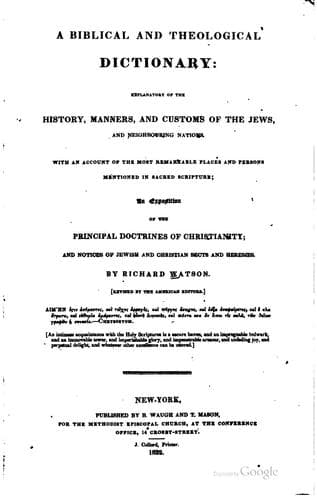
A Biblical and Theological Dictionary: explanatory of the history, manners, and customs of the Jews, and neighbouring nationsWatson, Richard
Religion
A Biblical and Theological Dictionary: explanatory of the history, manners, and customs of the Jews, and neighbouring nations
Watson, Richard
Bible -- Dictionaries; Theology -- Dictionaries
To this he added that of Lysanias; and Agrippa returned
very soon into Judea, to take possession of his new kingdom. The emperor
Caius, desiring to be adored as a god, commanded to have his statue set
up in the temple of Jerusalem. But the Jews opposed this design with so
much resolution, that Petronius was forced to suspend his proceedings in
this affair, and to represent, in a letter to the emperor, the
resistance he met with from the Jews. Agrippa, who was then at Rome,
coming to the emperor at the very time he was reading the letter, Caius
told him that the Jews were the only people of all mankind who refused
to own him for a deity; and that they had taken arms to oppose his
resolution. At these words Agrippa fainted away, and, being carried home
to his house, continued in that state for a long time. As soon as he was
somewhat recovered, he wrote a long letter to Caius, wherein he
endeavoured to soften him; and his arguments made such an impression
upon the emperor’s mind, that he desisted, in appearance, from the
design which he had formed of setting up his statue in the temple. Caius
being killed in the beginning of the following year, A. D. 41, Agrippa,
who was then at Rome, contributed much by his advice to maintain
Claudius in possession of the imperial dignity, to which he had been
advanced by the army. The emperor, as an acknowledgment for his kind
offices, gave him all Judea, and the kingdom of Chalcis, which had been
possessed by Herod his brother. Thus Agrippa became of a sudden one of
the greatest princes of the east, and was possessed of as much, if not
more territory, than had been held by Herod the Great, his grandfather.
He returned to Judea, and governed it to the great satisfaction of the
Jews. But the desire of pleasing them, and a mistaken zeal for their
religion, induced him to put to death the Apostle James, and to cast
Peter into prison with the same design; and, but for a miraculous
interposition, which, however, produced no effect upon the mind of the
tyrant, his hands would have been imbrued in the blood of two Apostles,
the memory whereof is preserved in Scripture. At Cæsarea, he had games
performed in honour of Claudius. Here the inhabitants of Tyre and Sidon
waited on him to sue for peace. Agrippa being come early in the morning
into the theatre, with a design to give them audience, seated himself on
his throne, dressed in a robe of silver tissue, worked in the most
admirable manner. The rising sun darted his golden beams thereon, and
gave it such a lustre as dazzled the eyes of the spectators; and when
the king began his speech to the Tyrians and Sidonians, the parasites
around him began to say, it was “the voice of a god and not of man.”
Instead of rejecting these impious flatteries, Agrippa received them
with an air of complacency; and the angel of the Lord smote him because
he did not give God the glory. Being therefore carried home to his
palace, he died, at the end of five days, racked with tormenting pains
Public-domain text, read in full here on John Shaqi.
Reviews
Reviews
No reviews yet
Be the first to share your thoughts on this work.
Elsewhere in the archive
Join the Discussion
Join the discussion
Sign in to leave a comment or review.
Sign InorCreate an account