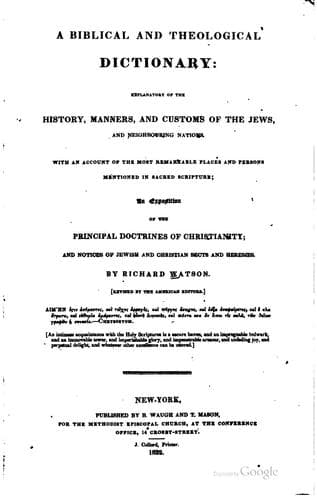
A Biblical and Theological Dictionary: explanatory of the history, manners, and customs of the Jews, and neighbouring nationsWatson, Richard
Religion
A Biblical and Theological Dictionary: explanatory of the history, manners, and customs of the Jews, and neighbouring nations
Watson, Richard
Bible -- Dictionaries; Theology -- Dictionaries
in his bowels, and devoured with worms. Such was the death of Herod
Agrippa, A. D. 44, after a reign of seven years. He left a son of the
same name, and three daughters--Bernice, who was married to her uncle
Herod, her father’s brother; Mariamne, betrothed to Julius Archelaus;
and Drusilla, promised to Epiphanius, the son of Archelaus, the son of
Comagena.
AGRIPPA, son of the former Agrippa, was at Rome with the emperor
Claudius when his father died. The emperor, we are told by Josephus, was
inclined to give him all the dominions that had been possessed by his
father, but was dissuaded from it, Agrippa being only seventeen years of
age; and he kept him therefore at his court four years.
Three years after this, Herod, king of Chalcis, and uncle to young
Agrippa, dying, the emperor gave his dominions to this prince, who,
notwithstanding, did not go into Judea till four years after, A. D. 53;
when, Claudius taking from him the kingdom of Chalcis, gave him the
provinces of Gaulonitis, Trachonitis, Batanæa, Paneas, and Abylene,
which formerly had been in the possession of Lysanias. After the death
of Claudius, his successor, Nero, who had a great affection for Agrippa,
to his other dominions added Julias in Peræa, and that part of Galilee
to which Tarichæa and Tiberias belonged. Festus governor of Judea,
coming to his government, A. D. 60, king Agrippa and Bernice, his
sister, went as far as Cæsarea to salute him; and as they continued
there for some time, Festus talked with the king concerning the affair
of St. Paul, who had been seized in the temple about two years before,
and within a few days previous to his visit had appealed to the emperor.
Agrippa wishing to hear Paul, that Apostle delivered that noble address
in his presence which is recorded, Acts xxvi.
AGUR. The thirtieth chapter of Proverbs begins with this title: “The
words of Agur, the son of Jakeh;” and the thirty-first, with “the words
of king Lemuel;” with respect to which some conjecture that Solomon
describes himself under these appellations; others, that these chapters
are the productions of persons whose real names are prefixed. Scripture
history, indeed, affords us no information respecting their situation
and character; but there must have been sufficient reason for regarding
their works in the light of inspired productions, or they would not have
been admitted into the sacred canon.
Public-domain text, read in full here on John Shaqi.
Reviews
Reviews
No reviews yet
Be the first to share your thoughts on this work.
Elsewhere in the archive
Join the Discussion
Join the discussion
Sign in to leave a comment or review.
Sign InorCreate an account