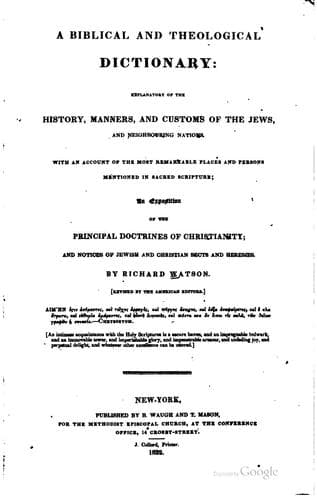
A Biblical and Theological Dictionary: explanatory of the history, manners, and customs of the Jews, and neighbouring nationsWatson, Richard
Religion
A Biblical and Theological Dictionary: explanatory of the history, manners, and customs of the Jews, and neighbouring nations
Watson, Richard
Bible -- Dictionaries; Theology -- Dictionaries
They are called _Massa_, a term frequently applied to the undoubted
productions of the prophetic Spirit; and it is not improbable that the
authors meant, by the adoption of this term, to lay claim to the
character of inspiration. A succession of virtuous and eminent men,
favoured with divine illuminations, flourished in Judea till the final
completion of the sacred code; and, most likely, many more than those
whose writings have been preserved. Agur may then have been one of those
prophets whom Divine providence raised up to comfort or admonish his
chosen people; and Lemuel may have been some neighbouring prince, the
son of a Jewish woman, by whom he was taught the Massa contained in the
thirty-first chapter. These, of course, can only be considered as mere
conjectures; for, in the absence of historic evidence, who can venture
to pronounce with certainty? The opinion, however, that Agur and Lemuel
are appellations of Solomon, is sanctioned by so many and such
respectable writers, that it demands a more particular examination.
The knowledge of names was anciently regarded as a matter of the highest
importance, in order to understand the nature of the persons or things
which they designate; and, in the opinion of the rabbins, was preferable
even to the study of the written law. The Heathens paid considerable
attention to it, as appears from the Cratylus of Plato; and some of the
Christian fathers entertained very favourable notions of such knowledge.
The Jewish doctors, it is true, refined upon the subject with an amazing
degree of subtilty, grounding upon it many ridiculous ideas and absurd
fancies; yet it is unquestionable that many of the proper names in
Scripture are significant and characteristic. Thus the names Eve, Cain,
Seth, Noah, Abraham, Israel, &c, were imposed by reason of their being
expressive of the several characters of the persons whom they represent.
Reasoning from analogy, we may infer that all the proper names in the
Old Testament, at their original imposition, were intended to denote
some quality or circumstance in the person or thing to which they
belong; and though many, from transference, have ceased to be personally
characteristic, yet are they all significative.
Public-domain text, read in full here on John Shaqi.
Reviews
Reviews
No reviews yet
Be the first to share your thoughts on this work.
Elsewhere in the archive
Join the Discussion
Join the discussion
Sign in to leave a comment or review.
Sign InorCreate an account