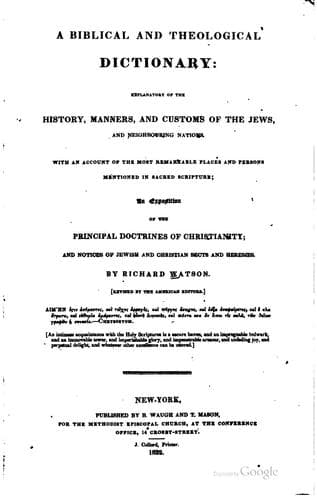
A Biblical and Theological Dictionary: explanatory of the history, manners, and customs of the Jews, and neighbouring nationsWatson, Richard
Religion
A Biblical and Theological Dictionary: explanatory of the history, manners, and customs of the Jews, and neighbouring nations
Watson, Richard
Bible -- Dictionaries; Theology -- Dictionaries
As the custom of imposing descriptive names prevailed in the primitive
ages, it is not impossible that Agur and Lemuel may be appropriated to
Solomon, and Jakeh to David as mystic appellations significative of
their respective characters. It is even some confirmation of this
opinion, that Solomon is denominated Jedidiah (beloved of the Lord) by
the Prophet Nathan; and that in the book of Ecclesiastes, he styles
himself Koheleth, or the Preacher. Nevertheless, this hypothesis does
not appear to rest upon a firm foundation. It is foreign to the
simplicity of the sacred penmen, and contrary to their custom in similar
cases, to adopt a mystic name, without either explaining it, or alleging
the reasons for its adoption. In the names Eve, Cain, Seth, Noah, &c,
before alluded to; in the appellation Nabal; in the enigmatical names in
the first chapter of Hosea; in the descriptive names given to places, as
Beersheba, Jehovah-jireh, Peniel, Bethel, Gilgal; and in many other
instances, the meaning of the terms is either explained, or the
circumstances are mentioned which led to their selection. When Solomon
is called Jedidiah, it is added that it was “because of the Lord;” and
when he styles himself Koheleth, an explanatory clause is annexed,
describing himself “the son of David, the king of Jerusalem.” But if
Solomon be meant by the titles Agur and Lemuel, he is so called without
any statement of the reasons for their application, and without any
explanation of their import; a circumstance unusual with the sacred
writers, and the reverse to what is practised in the book of Proverbs,
where his proper name, Solomon, is attributed to him in three different
places. Nor is anything characteristic of the Jewish monarchs
discoverable in the terms themselves. Jakeh, which denotes _obedient_,
is no more applicable to David than to Nathan, or any other personage of
eminent worth and piety among the Israelites. The name of Agur is not of
easy explanation; some giving it the sense of _recollectus_, that is,
recovered from his errors, and become penitent; an explanation more
applicable to David than to Solomon. Simon, in his lexicon, says it may
perhaps denote “him who applies to the study of wisdom;” an
interpretation very suitable to the royal philosopher, but not supported
by adequate authority; and in his Onomasticon he explains it in a
different manner. Others suppose that it means _collector_; though it
has been argued, that, as it has a passive form, it cannot have an
active sense. But this is not a valid objection, as several examples may
be produced from the Bible of a similar form with an active
signification. If such be its meaning, it is suitable to Solomon, who
was not the collector or compiler, but the author, of the Proverbs. With
respect to the name Lemuel, it signifies one that is for God, or devoted
to God; and is not, therefore, peculiarly descriptive of Solomon. It
appears, then, that nothing can be inferred from the signification of
Public-domain text, read in full here on John Shaqi.
Reviews
Reviews
No reviews yet
Be the first to share your thoughts on this work.
Elsewhere in the archive
Join the Discussion
Join the discussion
Sign in to leave a comment or review.
Sign InorCreate an account