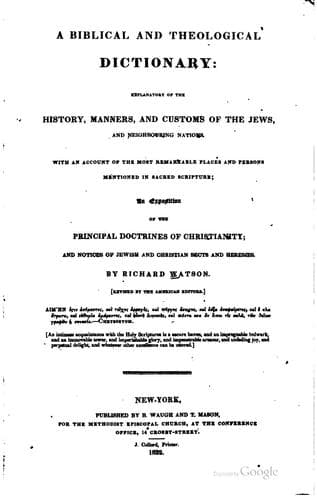
A Biblical and Theological Dictionary: explanatory of the history, manners, and customs of the Jews, and neighbouring nationsWatson, Richard
Religion
A Biblical and Theological Dictionary: explanatory of the history, manners, and customs of the Jews, and neighbouring nations
Watson, Richard
Bible -- Dictionaries; Theology -- Dictionaries
AICHMALOTARCH, Ἀιχμαλοτάρχης signifies _the prince of the captivity_, or
_chief of the captives_. The Jews pretend that this was the title of him
who had the government of their people during the captivity of Babylon;
and they believe these princes or governors to have been constantly of
the tribe of Judah, and family of David. But they give no satisfactory
proof of the real existence of these Aichmalotarchs. There was no prince
of the captivity before the end of the second century, from which period
the office continued till the eleventh century. The princes of the
captivity resided at Babylon, where they were installed with great
ceremony, held courts of justice, &c, and were set over the eastern
Jews, or those settled in Babylon, Chaldæa, Assyria, and Persia. Thus
they affected to restore the splendour of their ancient monarchy, and in
this view the following account may be amusing. The ceremonial of the
installation is thus described: The spiritual heads of the people, the
masters of the learned schools, the elders, and the people, assembled in
great multitudes within a stately chamber, adorned with rich curtains,
in Babylon, where, during his days of splendour, the Resch-Glutha fixed
his residence. The prince was seated on a lofty throne. The heads of the
schools of Sura and Pumbeditha on his right hand and left. These chiefs
of the learned men then delivered an address, exhorting the new monarch
not to abuse his power; and reminded him that he was called to slavery
rather than to sovereignty, for he was prince of a captive people. On
the next Thursday he was inaugurated by the laying on of hands, and the
sound of trumpets, and acclamations. He was escorted to his palace with
great pomp, and received magnificent presents from all his subjects. On
the Sabbath all the principal people being assembled before his house,
he placed himself at their head, and, with his face covered with a
silken veil, proceeded to the synagogue. Benedictions and hymns of
thanksgiving announced his entrance. They then brought him the book of
the law, out of which he read the first line, afterward he addressed the
assembly, with his eyes closed out of respect. He exhorted them to
charity, and set the example by offering liberal alms to the poor. The
ceremony closed with new acclamations, and prayers to God that, under
the new prince, he would be pleased to put an end to their calamities.
The prince gave his blessing to the people, and prayed for each
province, that it might be preserved from war and famine. He concluded
his orisons in a low voice, lest his prayer should be repeated to the
jealous ears of the native monarchs, for he prayed for the restoration
of the kingdom of Israel, which could not rise but on the ruins of their
empire. The prince returned to his palace, where he gave a splendid
banquet to the chief persons of the community. After that day he lived
in a sort of stately oriental seclusion, never quitting his palace,
Public-domain text, read in full here on John Shaqi.
Reviews
Reviews
No reviews yet
Be the first to share your thoughts on this work.
Elsewhere in the archive
Join the Discussion
Join the discussion
Sign in to leave a comment or review.
Sign InorCreate an account