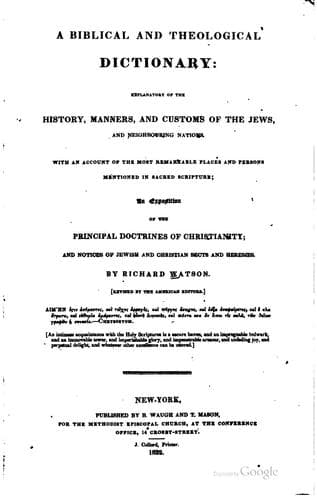
A Biblical and Theological Dictionary: explanatory of the history, manners, and customs of the Jews, and neighbouring nationsWatson, Richard
Religion
A Biblical and Theological Dictionary: explanatory of the history, manners, and customs of the Jews, and neighbouring nations
Watson, Richard
Bible -- Dictionaries; Theology -- Dictionaries
except to go to the schools of the learned, where, as he entered, the
whole assembly rose and continued standing, till he took his seat. He
sometimes paid a visit to the native sovereign in Babylon (Bagdad.) This
probably refers to a somewhat later period. On these great occasions his
imperial host sent his own chariot for his guest; but the prince of the
captivity dared not accept the invidious distinction, he walked in
humble and submissive modesty behind the chariot. Yet his own state was
by no means wanting in splendour: he was arrayed in cloth of gold; fifty
guards marched before him; all the Jews who met him on the way paid
their homage, and fell behind into his train. He was received by the
eunuchs, who conducted him to the throne, while one of his officers, as
he marched slowly along, distributed gold and silver on all sides. As
the prince approached the imperial throne, he prostrated himself on the
ground, in token of vassalage. The eunuchs raised him and placed him on
the left hand of the sovereign. After the first salutation, the prince
represented the grievances, or discussed the affairs, of his people.
The court of the Resch-Glutha is described as splendid. In imitation of
his Persian master, he had his officers, counsellors, and cup-bearers;
and rabbins were appointed as satraps over the different communities.
This state, it is probable, was maintained by a tribute raised from the
body of the people, and substituted for that which, in ancient times was
paid for the temple in Jerusalem. His subjects in Babylonia were many of
them wealthy.
AIJALON, a city of the Canaanites; the valley adjoining to which is
memorable in sacred history from the miracle of Joshua, in arresting the
course of the sun and moon, that the Israelites might have sufficient
light to pursue their enemies, Joshua x, 12, 13. Aijalon was afterward a
Levitical city, and belonged to the tribe of Dan; who did not, however,
drive out the Amorite inhabitants, Judges i, 35.
AIR, that thin, fluid, elastic, transparent, ponderous, compressible
body which surrounds the terraqueous globe to a considerable height. In
Scripture it is sometimes used for _heaven_; as, “the birds of the air;”
“the birds of heaven.” To “beat the air,” and “to speak to the air,” 1
Cor. ix, 26, signify to fatigue ourselves in vain, and to speak to no
purpose. “The prince of the power of the air” is the head and chief of
the evil spirits, with which both Jews and Heathens thought the air was
filled.
Public-domain text, read in full here on John Shaqi.
Reviews
Reviews
No reviews yet
Be the first to share your thoughts on this work.
Elsewhere in the archive
Join the Discussion
Join the discussion
Sign in to leave a comment or review.
Sign InorCreate an account