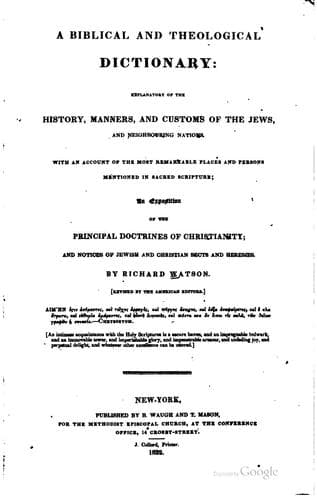
A Biblical and Theological Dictionary: explanatory of the history, manners, and customs of the Jews, and neighbouring nationsWatson, Richard
Religion
A Biblical and Theological Dictionary: explanatory of the history, manners, and customs of the Jews, and neighbouring nations
Watson, Richard
Bible -- Dictionaries; Theology -- Dictionaries
ABANA. Naaman, the leper, on being directed to wash in the river Jordan,
says, 2 Kings v, 12, “Are not Abana and Pharpar, rivers of Damascus,
better than all the waters of Israel?” Probably the Abana is a branch of
the Barrady, or Chrysorrhoas, which derives its source from the foot of
mount Libanus, eastward; runs round and through Damascus, and continues
its course till lost in the wilderness, four or five leagues south of
the city. Benjamin of Tudela will have that part of Barrady which runs
through Damascus to be the Abana, and the streams which water the
gardens without the city, to be Pharpar; but perhaps the Pharpar is the
same with Orontes, the most noted river of Syria, which, taking its rise
a little to the north or north-east of Damascus, glides through a
delightful plain, till, after passing Antioch, and running about two
hundred miles to the north-west, it loses itself in the Mediterranean
sea, 2 Kings v, 12.
ABBA, a Syriac word, which signifies _father_. The learned Mr. Selden,
from the Babylonian Gemara, has proved that slaves were not allowed to
use the title abba in addressing the master of the family to which they
belonged. This may serve to illustrate Rom. viii, 15, and Gal. iv, 6, as
it shows that through faith in Christ all true Christians pass into the
relation of sons; are permitted to address God with filial confidence in
prayer; and to regard themselves as heirs of the heavenly inheritance.
This adoption into the family of God, inseparably follows our
justification; and the power to call God our Father, in this special and
appropriative sense, results from the inward testimony given to our
forgiveness by the Holy Spirit. St. Paul and St. Mark use the Syriac
word _abba_, a term which was understood in the synagogues and primitive
assemblies of Christians; but added to it when writing to foreigners the
explanation, _father_. Figuratively, abba means also a superior, in
respect of age, dignity, or affection. It is more particularly used in
the Syriac, Coptic, and Ethiopic churches as a title given to their
bishops. The bishops themselves bestow the title abba more eminently
upon the bishop of Alexandria, which occasioned the people to give him
the title of baba, or papa, that is, grandfather; a title which he bore
before the bishop of Rome.
Public-domain text, read in full here on John Shaqi.
Reviews
Reviews
No reviews yet
Be the first to share your thoughts on this work.
Join the Discussion
Join the discussion
Sign in to leave a comment or review.
Sign InorCreate an account