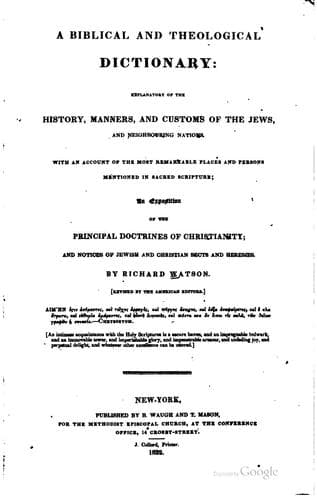
A Biblical and Theological Dictionary: explanatory of the history, manners, and customs of the Jews, and neighbouring nationsWatson, Richard
Religion
A Biblical and Theological Dictionary: explanatory of the history, manners, and customs of the Jews, and neighbouring nations
Watson, Richard
Bible -- Dictionaries; Theology -- Dictionaries
AB, in the Hebrew chronology, the eleventh month of the civil year, and
the fifth of the ecclesiastical year, which began with Nisan. This month
answered to the moon of July, comprehending part of July and of August,
and contained thirty days.
The first day of this month is observed as a fast by the Jews, in memory
of Aaron’s death; and the ninth, in commemoration of the destruction of
the temple by Nebuchadnezzar, in the year before Christ 587. Josephus
observes, that the burning of the temple by Nebuchadnezzar happened on
the same day of the year on which it was afterward burned by Titus. The
same day was remarkable for Adrian’s edict, which prohibited the Jews to
continue in Judea, or to look toward Jerusalem and lament its
desolation. The eighteenth day is also kept as a fast, because the
sacred lamp was extinguished on that night, in the reign of Ahaz. On the
twenty-first, or, according to Scaliger, the twenty-second day, was a
feast called Xylophoria, from their laying up the necessary wood in the
temple: and on the twenty-fourth, a feast in commemoration of the
abolishing of a law by the Asmoneans, or Maccabees, which had been
introduced by the Sadducees, and which enacted, that both sons and
daughters should alike inherit the estate of their parents.
ABADDON, Heb. corresponding to _Apollyon_, Gr. that is, _Destroyer_, is
represented, Rev. ix, 11, as king of the locusts, and the angel of the
bottomless pit. Le Clerc and Dr. Hammond understand by the locusts in
this passage, the zealots and robbers who infested and desolated Judea
before Jerusalem was taken by the Romans; and by Abaddon, John of
Gischala, who having treacherously left that town before it was
surrendered to Titus, came to Jerusalem and headed those of the zealots
who acknowledged him as their king, and involved the Jews in many
grievous calamities. The learned Grotius concurs in opinion, that the
locusts are designed to represent the sect of the zealots, who appeared
among the Jews during the siege, and at the time of the destruction of
Jerusalem. But Mr. Mede remarks, that the title Abaddon alludes to
Obodas, the common name of the ancient monarchs of that part of Arabia
from which Mohammed came; and considers the passage as descriptive of
the inundation of the Saracens. Mr. Lowman adopts and confirms this
interpretation. He shows that the rise and progress of the Mohammedan
religion and empire exhibit a signal accomplishment of this prophecy.
All the circumstances here recited correspond to the character of the
Arabians, and the history of the period that extended from A. D. 568 to
A. D. 675. In conformity to this opinion, Abaddon may be understood to
denote either Mohammed, who issued from the abyss, or the cave of Hera,
to propagate his pretended revelations, or, more generally, the Saracen
power. Mr. Bryant supposes Abaddon to have been the name of the Ophite
deity, the worship of whom prevailed very anciently and very generally.
Public-domain text, read in full here on John Shaqi.
Reviews
Reviews
No reviews yet
Be the first to share your thoughts on this work.
Join the Discussion
Join the discussion
Sign in to leave a comment or review.
Sign InorCreate an account