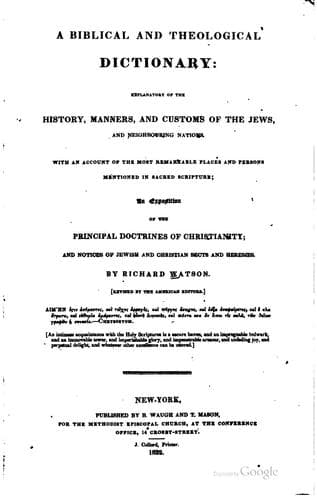
A Biblical and Theological Dictionary: explanatory of the history, manners, and customs of the Jews, and neighbouring nationsWatson, Richard
Religion
A Biblical and Theological Dictionary: explanatory of the history, manners, and customs of the Jews, and neighbouring nations
Watson, Richard
Bible -- Dictionaries; Theology -- Dictionaries
changed, the image is gradually advanced, and the metaphor is joined
with a comparison that is repeated.
“He stoopeth down, he coucheth as a lion;
And as a lioness; who shall rouse him?”
A similar instance occurs in the prophecy, recorded in Psalm cx, 3,
which explicitly foretels the abundant increase of the Gospel on its
first promulgation. This kind of allegory, however, sometimes assumes a
more regular and perfect form, and then occupies the whole subject and
compass of the discourse. An example of this kind occurs in Solomon’s
well known allegory, Eccles. xii, 2–6, in which old age is so admirably
depicted. There is also, in Isaiah xxviii, 24–29, an allegory, which,
with no less elegance of imagery, is more simple and regular, as well as
more just and complete, both in the form and the method of treating it.
Another kind of allegory is that which, in the proper and more
restricted sense, may be called a parable; and consists of a continued
narration of some fictitious event, accommodated, by way of similitude,
to the illustration of some important truth. The Greeks call these
allegories αινοι or apologues, and the Latins _fabulæ_, or fables. (See
_Parable_.) The third species of allegory, which often occurs in the
prophetic poetry, is that in which a double meaning is couched under the
same words, or when the same discourse, differently interpreted,
designates different events, dissimilar in their nature, and remote as
to time. These different relations are denominated the literal and
mystical senses. This kind of allegory, which the learned prelate calls
mystical, seems to derive its origin from the principles of the Jewish
religion; and it differs from the two former species in a variety of
respects. In these allegories the writer may adopt any imagery that is
most suitable to his fancy or inclination; but the only proper materials
for this allegory must be supplied from the sacred rites of the Hebrews
themselves; and it can only be introduced in relation to such things as
are immediately connected with the Jewish religion, or their immediate
opposites. The former kinds partake of the common privileges of poetry;
but the mystical allegory has its foundation in the nature of the Jewish
economy, and is adapted solely to the poetry of the Hebrews. Besides, in
the other forms of allegory, the exterior or ostensible imagery is mere
fiction, and the truth lies altogether in the interior or remote sense;
but in this allegory each idea is equally agreeable to truth. The
exterior or ostensible image is itself a reality; and although it
sustains another character, it does not wholly lay aside its own. There
is also a great variety in the use and conduct of the mystical allegory;
in the modes in which the corresponding images are arranged, and in
which they are obscured or eclipsed by one another. Sometimes the
obvious or literal sense is so prominent and conspicuous, both in the
Public-domain text, read in full here on John Shaqi.
Reviews
Reviews
No reviews yet
Be the first to share your thoughts on this work.
Elsewhere in the archive
Join the Discussion
Join the discussion
Sign in to leave a comment or review.
Sign InorCreate an account