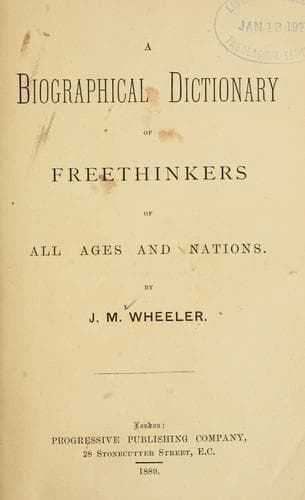
A Biographical Dictionary of Freethinkers of All Ages and NationsWheeler, J. M. (Joseph Mazzini)
Religion
A Biographical Dictionary of Freethinkers of All Ages and Nations
Wheeler, J. M. (Joseph Mazzini)
Free thought -- Biography
Antoine (Nicolas). Martyr. Denied the Messiahship and divinity of
Jesus, and was strangled and burnt at Geneva, 20 April, 1632.
Antonelle (Pierre Antoine) Marquis d', French political economist,
b. Arles 1747. He embraced the revolution with ardor, and his article
in the Journal des Hommes Libres occasioned his arrest with Baboeuf. He
was, however, acquitted. Died at Arles, 26 Nov. 1817.
Antoninus (Marcus Aurelius). See Aurelius.
Apelt (Ernst Friedrich), German philosopher, b. Reichenau 3 March,
1812. He criticised the philosophy of religion from the standpoint
of reason, and wrote many works on metaphysics. Died near Gorlitz,
27 Oct. 1859.
Aquila, a Jew of Pontus, who became a proselyte to Christianity, but
afterwards left that religion. He published a Greek version of the
Hebrew scriptures to show that the prophecies did not apply to Jesus
(A.D. 128). The work is lost. He has been identified by E. Deutsch
with the author of the Targum of Onkelos.
Arago (Dominique François Jean), French academician, politician,
physicist and astronomer, b. Estagel, 26 Feb. 1786. He was elected to
the French Academy of Sciences at the age of twenty-three. He made
several optical and electro-magnetic discoveries, and advocated
the undulatory theory of light. He was an ardent Republican and
Freethinker, and took part in the provisional Government of 1848. He
opposed the election of Louis Napoleon, and refused to take the
oath of allegiance after the coup d'état of December, 1851. Died 2
Oct. 1853. Humboldt calls him a "zealous defender of the interests
of Reason."
Ardigo (Roberto), Italian philosopher, b. at Casteldidone (Cremona)
28 Jan. 1828, was intended for the Church, but took to philosophy. In
1869 he published a discourse on Peitro Pomponazzi, followed next year
by Psychology as a Positive Science. Signor Ardigo has also written on
the formation of the solar system and on the historical formation of
the ideas of God and the soul. An edition of his philosophical works
was commenced at Mantua in 1882. Ardigo is one of the leaders of the
Italian Positivists. His Positivist Morals appeared in Padua 1885.
Argens (Jean Baptiste de Boyer) Marquis d', French writer, b. at
Aix, in Provence, 24 June 1704. He adopted a military life and
served with distinction. On the accession of Frederick the Great
he invited d'Argens to his court at Berlin, and made him one of his
chamberlains. Here he resided twenty-five years and then returned to
Aix, where he resided till his death 11 June, 1771. His works were
published in 1768 in twenty-four volumes. Among them are Lettres
Juives, Lettres Chinoises and Lettres Cabalistiques, which were
joined to La Philosophie du bon sens. He also translated Julian's
discourse against Christianity and Ocellus Lucanus on the Eternity
of the World. Argens took Bayle as his model, but he was inferior to
that philosopher.
Public-domain text, read in full here on John Shaqi.
Reviews
Reviews
No reviews yet
Be the first to share your thoughts on this work.
Join the Discussion
Join the discussion
Sign in to leave a comment or review.
Sign InorCreate an account