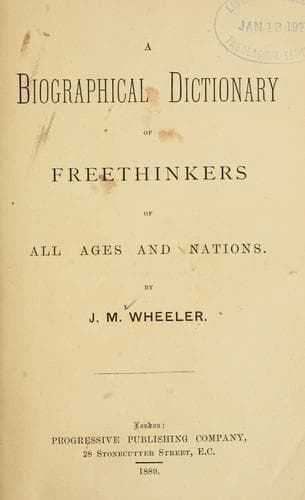
A Biographical Dictionary of Freethinkers of All Ages and NationsWheeler, J. M. (Joseph Mazzini)
Religion
A Biographical Dictionary of Freethinkers of All Ages and Nations
Wheeler, J. M. (Joseph Mazzini)
Free thought -- Biography
Argental (Charles Augustin de Ferriol) Count d', French diplomat,
b. Paris 20 Dec. 1700, was a nephew of Mme. de Tencin, the mother
of D'Alembert. He is known for his long and enthusiastic friendship
for Voltaire. He was said to be the author of Mémoires du Comte de
Comminge and Anecdotes de la cour d'Edouard. Died 5 Jan. 1788.
Aristophanes, great Athenian comic poet, contemporary with Socrates,
Plato, and Euripides, b. about 444 B.C. Little is known of his life. He
wrote fifty-four plays, of which only eleven remain, and was crowned
in a public assembly for his attacks on the oligarchs. With the utmost
boldness he satirised not only the the political and social evils
of the age, but also the philosophers, the gods, and the theology
of the period. Plato is said to have died with Aristophanes' works
under his pillow. Died about 380 B.C.
Aristotle, the most illustrious of ancient philosophers, was born at
Stagyra, in Thrace, 384 B.C. He was employed by Philip of Macedon
to instruct his son Alexander. His inculcation of ethics as apart
from all theology, justifies his place in this list. After the death
of Alexander, he was accused of impiety and withdrew to Chalcis,
where he died B.C. 322. Grote says: "In the published writings of
Aristotle the accusers found various heretical doctrines suitable for
sustaining their indictment; as, for example, the declaration that
prayer and sacrifices to the gods were of no avail." His influence
was predominant upon philosophy for nearly two thousand years. Dante
speaks of him as "the master of those that know."
Arnold of Brescia, a pupil of Abelard. He preached against the papal
authority and the temporal power, and the vices of the clergy. He
was condemned for heresy by a Lateran Council in 1139, and retired
from Italy. He afterwards returned to Rome and renewed his exertions
against sacerdotal oppression, and was eventually seized and burnt at
Rome in 1155. Baronius calls him "the patriarch of political heretics."
Public-domain text, read in full here on John Shaqi.
Reviews
Reviews
No reviews yet
Be the first to share your thoughts on this work.
Join the Discussion
Join the discussion
Sign in to leave a comment or review.
Sign InorCreate an account