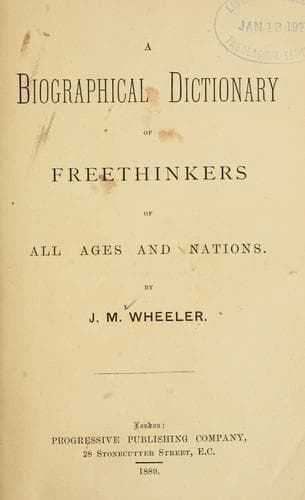
A Biographical Dictionary of Freethinkers of All Ages and NationsWheeler, J. M. (Joseph Mazzini)
Religion
A Biographical Dictionary of Freethinkers of All Ages and Nations
Wheeler, J. M. (Joseph Mazzini)
Free thought -- Biography
Hardwicke (Edward Arthur), M.D., eldest son of Junius Hardwicke,
F.R.C.S., of Rotherham, Yorks. In '75 he qualified as a surveyor, and
in '86 as a physician. For twelve years he was Surgeon Superintendent
of the Government Emigration Service. He is an Agnostic of the school
of Herbert Spencer, and has contributed to Freethought and scientific
periodicals.
Hardwicke (Herbert Junius), M.D., brother of above, b. Sheffield, 26
Jan. 1850. Studied at London, Edinburgh and Paris. In '78 he became a
member of the Edinburgh College of Physicians. Next year he was the
principal agent in establishing the Sheffield Public Hospital for
Skin Diseases. Besides numerous medical works, Dr. Hardwicke set up
a press of his own in order to print The Popular Faith Unveiled, the
publishers requiring guarantee in consequence of the prosecution of
Mr. Foote ('84), and Evolution and Creation ('87). He has contributed
to the Agnostic Annual, and has recently written Rambles in Spain,
Italy and Morocco ('89).
Harriot (Thomas), English mathematician, b. Oxford, 1560, accompanied
Raleigh to Virginia and published an account of the expedition. He was
noted for his skill in algebra, and A. Wood says "He was a Deist." Died
21 July 1621.
Harrison (Frederic), M.A., English Positivist, b. London 18 Oct. 1831,
educated at London and Oxford, when he was 1st class in classics. He
was called to the bar in '58. He has since been appointed Professor
of Jurisprudence and International Law. He has written many important
articles in the high-class reviews, and has published The Meaning
of History, Order and Progress, and on The Choice of Books and Other
Literary Pieces, '86, and has translated vol. ii of Comte's Positive
Polity. He was one of the founders of the Positivist school, '70,
and of Newton Hall in '81. A fine stylist, his addresses and magazine
articles bear the stamp of a cultured man of letters.
Hartmann (Karl Robert Eduard), German pantheistic pessimist
philosopher, b. Berlin, 23 Feb. 1842. In '58 he entered the Prussian
army, but an affection of the knee made him resign in '65. By the
publication of his Philosophy of the Unconscious in '69, he became
famous, though it was not translated into English until '84. He
has since written numerous works of which we name Self-Dissolution
of Christianity and The Religion of the Future, '75, The Crisis of
Christianity in Modern Theology, '80, The Religious Consciousness of
Mankind, '81, and Modern Problems, '86. Latterly Hartmann has turned
his attention to the philosophy of politics.
Public-domain text, read in full here on John Shaqi.
Reviews
Reviews
No reviews yet
Be the first to share your thoughts on this work.
Elsewhere in the archive
Join the Discussion
Join the discussion
Sign in to leave a comment or review.
Sign InorCreate an account