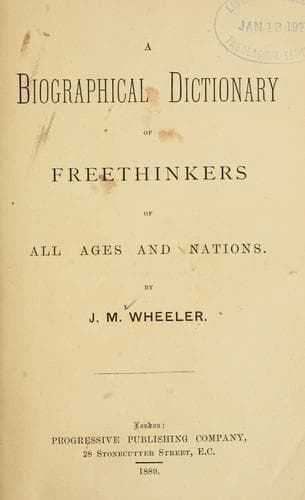
A Biographical Dictionary of Freethinkers of All Ages and NationsWheeler, J. M. (Joseph Mazzini)
Religion
A Biographical Dictionary of Freethinkers of All Ages and Nations
Wheeler, J. M. (Joseph Mazzini)
Free thought -- Biography
Haureau (Jean Barthelemy), French historian, b. Paris 1812. At the
age of twenty he showed his sympathy with the Revolution by a work
on The Mountain. In turn journalist and librarian he has produced
many important works, of which we name his Manual of the Clergy,
'44, which drew on him attacks from the clericals, and his erudite
Critical Examination of the Scholastic Philosophy, '50.
Hauy (Valentine), French philanthropist, b. Saint-Just 13 Nov. 1745. He
devoted much attention to enabling the blind to read and founded the
institute for the young blind in 1784. He was one of the founders
of Theophilantropy. In 1807 he went to Russia, where he stayed till
1817, devoting himself to the blind and to telegraphy. Died at Paris
18 March, 1822.
Havet (Ernest August Eugène), French scholar and critic, b. Paris,
11 April, 1813. In '40 he was appointed professor of Greek literature
at the Normal School. In '55 he was made professor of Latin eloquence
at the Collége de France. In '63 an article on Renan's Vie de Jesus in
the Revue des Deux Mondes excited much attention, and was afterwards
published separately. His work on Christianity and its Origins,
4 vols. 1872-84, is a masterpiece of rational criticism.
Hawkesworth (John), English essayist and novelist, b. in London about
1715. Became contributor to the Gentleman's Magazine and editor of
the Adventurer. In '61 he edited Swift's works with a life of that
author. He compiled an account of the voyages of Byron, Wallis,
Carteret, and Cook for government, for which he received £6,000;
but the work was censured as incidentally attacking the doctrine of
Providence. His novel Almoran and Hamet was very popular. Died at
Bromley, Kent, 17 Nov. 1773.
Hawley (Henry), a Scotch major-general, who died in 1765, and by the
terms of his will prohibited Christian burial.
Hebert (Jacques René), French revolutionist, b. Alençon 15 Nov. 1757,
published the notorious Père Duchêsne, and with Chaumette instituted
the Feasts of Reason. He was denounced by Saint Just, and guillotined
2 March 1794. His widow, who had been a nun, was executed a few
days later.
Hegel (Georg Wilhelm Friedrich), German metaphysician b. Stuttgart,
27 Aug. 1770. He studied theology at Tübingen, but, becoming acquainted
with Schelling, devoted his attention to philosophy. His Encyclopædia
of the Philosophical Sciences made a deep impression in Germany, and
two schools sprang up, one claiming it as a philosophical statement
of Christianity, the other as Pantheism hostile to revelation. Hegel
said students of philosophy must begin with Spinozism. He is said to
have remarked that of all his many disciples only one understood him,
and he understood him falsely. He was professor at Jena, Heidelberg,
and Berlin, in which last city he died 14 Nov. 1831, and was buried
beside Fichte.
Public-domain text, read in full here on John Shaqi.
Reviews
Reviews
No reviews yet
Be the first to share your thoughts on this work.
Elsewhere in the archive
Join the Discussion
Join the discussion
Sign in to leave a comment or review.
Sign InorCreate an account