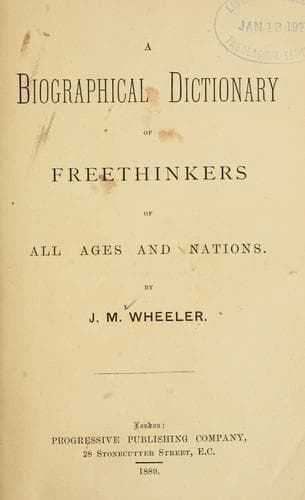
A Biographical Dictionary of Freethinkers of All Ages and NationsWheeler, J. M. (Joseph Mazzini)
Religion
A Biographical Dictionary of Freethinkers of All Ages and Nations
Wheeler, J. M. (Joseph Mazzini)
Free thought -- Biography
Hugo (Victor Marie), French poet and novelist, b. Besançon, 26
Feb. 1802. Was first noted for his Odes, published in '21. His dramas
"Hernani," '30, and "Marion Delorme," '31, were highly successful. He
was admitted into the French Academy in '41, and made a peer in
'45. He gave his cordial adhesion to the Republic of '48, and was
elected to the Assembly by the voters of Paris. He attacked Louis
Napoleon, and after the coup d'état was proscribed. He first went to
Brussels, where he published Napoleon the Little, a biting satire. He
afterwards settled at Guernsey, where he remained until the fall of
the Empire, producing The Legend of the Ages, '59, Les Miserables, '62,
Toilers of the Sea, '69, and other works. After his return to Paris he
produced a new series of the Legend of the Ages, The Pope, Religions
and Religion, Torquemada, and other poems. He died 22 May, 1885,
and it being decided he should have a national funeral, the Pantheon
was secularised for that purpose, the cross being removed. Since his
death a poem entitled The End of Satan has been published.
Hugues (Clovis), French Socialist, poet, and deputy, b. Menerbes,
3 Nov. 1850. In youth he desired to become a priest, but under the
influence of Hugo left the black business. In '71 he became head
of the Communist movement at Marseilles. He was sentenced to three
years' imprisonment. In '81 he was elected deputy, and sits on the
extreme left.
Humboldt (Friedrich Heinrich Alexander von), illustrious German
naturalist and traveller, b. Berlin, 14 Sept. 1769. He studied under
Heyne and Blumenbach, travelled in Holland, France and England
with George Forster, the naturalist, and became director-general
of mines. In 1799 he set out to explore South America and Mexico,
and in 1804 returned with a rich collection of animals, plants and
minerals. Humboldt became a resident of Paris, where he enjoyed
the friendship of Lalande, Delambre, Arago, and all the living
distinguished French scientists. After numerous important contributions
to scientific knowledge, at the age of seventy-four he composed his
celebrated Cosmos, the first volume of which appeared in '45 and the
fourth in '58. To Varnhagen von Ense he wrote in 1841: "Bruno Bauer
has found me pre-adamatically converted. Many years ago I wrote,
'Toutes les réligions positives offrent trois parties distinctes;
un traité de moeurs partout le même et très pur, un rève géologique,
et un mythe ou petit roman historique; le dernier élément obtient
le plus d'importance.'" Later on he says that Strauss disposes of
"the Christian myths." Humboldt was an unwearied student of science,
paying no attention to religion, and opposed his brother in regard to
his essay On the Province of the Historian, because he considered it
to acknowledge the belief in the divine government of the world, which
seemed to him as complete a delusion as the hypothesis of a principle
of life. He died in Berlin, 6 May, 1859, in his ninetieth year.
Public-domain text, read in full here on John Shaqi.
Reviews
Reviews
No reviews yet
Be the first to share your thoughts on this work.
Elsewhere in the archive
Join the Discussion
Join the discussion
Sign in to leave a comment or review.
Sign InorCreate an account