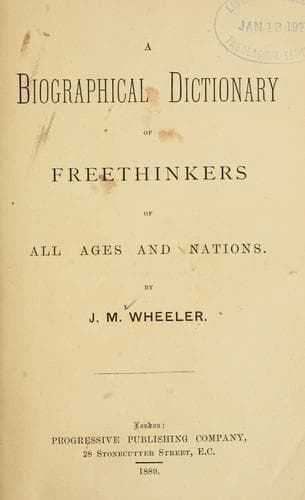
A Biographical Dictionary of Freethinkers of All Ages and NationsWheeler, J. M. (Joseph Mazzini)
Religion
A Biographical Dictionary of Freethinkers of All Ages and Nations
Wheeler, J. M. (Joseph Mazzini)
Free thought -- Biography
Assezat (Jules). French writer, b. at Paris 21 Jan. 1832 was a son
of a compositor on the Journal des Debats, on which Jules obtained a
position and worked his way to the editorial chair. He was secretary of
the Paris Society of Anthropology, contributed to La Pensée Nouvelle,
edited the Man Machine of Lamettrie, and edited the complete works
of Diderot in twenty volumes. Died 24 June, 1876.
Assollant (Jean, Baptiste Alfred). French novelist, b. 20 March,
1827. Larousse says he has all the scepticism of Voltaire.
Ast (Georg Anton Friedrich). German Platonist, b. Gotha 29
Dec. 1778. Was professor of classical literature at Landshut and
Munich. Wrote Elements of Philosophy, 1809, etc. Died Munich 31
Dec. 1841.
Atkinson (Henry George). Philosophic writer, b. in 1818. Was educated
at the Charterhouse, gave attention to mesmerism, and wrote in
the Zoist. In 1851 he issued Letters on the Laws of Man's Nature
and Development, in conjunction with Harriet Martineau, to whom he
served as philosophic guide. This work occasioned a considerable
outcry. Mr. Atkinson was a frequent contributor to the National
Reformer and other Secular journals. He died 28 Dec. 1884, at Boulogne,
where he had resided since 1870.
Aubert de Verse (Noel). A French advocate of the seventeenth century,
who wrote a history of the Papacy (1685) and was accused of blasphemy.
Audebert (Louise). French authoress of the Romance of a Freethinker
and of an able Reply of a Mother to the Bishop of Orleans, 1868.
Audifferent (Georges). Positivist and executor to Auguste Comte,
was born at Saint Pierre (Martinque) in 1823, settled at Marseilles,
and is the author of several medical and scientific works.
Aurelius (Marcus Antoninus). Roman Emperor and Stoic philosopher, b. at
Rome 26 April, 121. Was carefully educated, and lived a laborious,
abstemious life. On the death of his uncle Antoninus Pius, 161, the
Senate obliged him to take the government, but he associated with
himself L. Verus. On the death of Verus in 169 Antoninus possessed
sole authority, which he exercised with wise discretion and great
glory. Much of his time was employed in defending the northern
frontiers of the empire against Teutonic barbarians. He had no
high opinion of Christians, speaking of their obstinacy, and it is
pretended many were put to death in the reign of one of the best
emperors that ever ruled. If so we may be assured it was for their
crimes. Ecclesiastical historians have invented another pious miracle
in a victory gained through the prayers of the Christians. Antoninus
held that duty was indispensable even were there no gods. His
Meditations, written in the midst of a most active life, breathe a
lofty morality, and are a standing refutation of the view that pure
ethics depend upon Christian belief. Died 17 March, 180.
Public-domain text, read in full here on John Shaqi.
Reviews
Reviews
No reviews yet
Be the first to share your thoughts on this work.
Join the Discussion
Join the discussion
Sign in to leave a comment or review.
Sign InorCreate an account