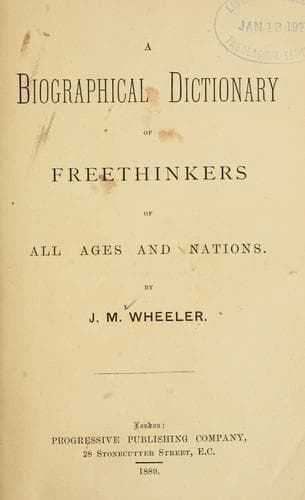
A Biographical Dictionary of Freethinkers of All Ages and Nations — John Shaqi
A Biographical Dictionary of Freethinkers of All Ages and NationsWheeler, J. M. (Joseph Mazzini)
Religion
A Biographical Dictionary of Freethinkers of All Ages and Nations
Wheeler, J. M. (Joseph Mazzini)
Free thought -- Biography
Austin (Charles), lawyer and disciple of Bentham, b. Suffolk 1799. At
Cambridge, where he graduated B.A. in 1824 and M.A. in 1827, he won,
much to the amazement of his friends, who knew his heterodox opinions,
the Hulsean prize for an essay on Christian evidences. For this he
was sorry afterwards, and told Lord Stanley of Alderley "I could
have written a much better essay on the other side." He afterwards
wrote on the other side in the Westminster Review. Successful as a
lawyer, he retired in ill-health. J. S. Mill writes highly of his
influence. The Hon. L. A. Tollemache gives a full account of his
heretical opinions. He says "He inclined to Darwinism, because as he
said, it is so antecedently probable; but, long before this theory
broke the back of final causes, he himself had given them up." Died
21 Dec. 1874.
Austin (John), jurist, brother of above, was born 3 March, 1790. A
friend of James Mill, Grote and Bentham, whose opinions he shared,
he is chiefly known by his profound works on jurisprudence. Died 17
Dec. 1859.
Avempace, i.e., Muhammad ibn Yahya ibn Bajjat (Abu Bekr), called
Ibn al-Saigh (the son of the goldsmith), Arabian philosopher and
poet, b. at Saragossa, practised medicine at Seville 1118, which he
quitted about 1120, and became vizier at the court of Fez, where he
died about 1138. An admirer of Aristotle, he was one of the teachers
of Averroes. Al-Fath Ibn Khâkân represents him as an infidel and
Atheist, and says: "Faith disappeared from his heart and left not a
trace behind; his tongue forgot the Merciful, neither did [the holy]
name cross his lips." He is said to have suffered imprisonment for
his heterodoxy.
Avenel (Georges), French writer, b. at Chaumont 31 Dec. 1828. One of
the promoters of the Encyclopédie Générale. His vindication of Cloots
(1865) is a solid work of erudition. He became editor of la République
Française and edited the edition of Voltaire published by Le Siècle
(1867-70). Died at Bougival, near Paris, 1 July, 1876, and was,
by his express wish, buried without religious ceremony.
Averroes (Muhammad Ibn-Ahmad Ibn Rushd), Abu al Walid, Arabian
philosopher, b. at Cordova in 1126, and died at Morocco 10
Dec. 1198. He translated and commented upon the works of Aristotle,
and resolutely placed the claims of science above those of theology. He
was prosecuted for his heretical opinions by the Muhammadan doctors,
was spat upon by all who entered the mosque at the hour of prayer,
and afterwards banished. His philosophical opinions, which incline
towards materialism and pantheism, had the honor of being condemned
by the University of Paris in 1240. They were opposed by St. Thomas
Aquinas, and when profoundly influencing Europe at the Renaissance
through the Paduan school were again condemned by Pope Leo X. in 1513.
Public-domain text, read in full here on John Shaqi.
Reviews
Reviews
No reviews yet
Be the first to share your thoughts on this work.
Join the Discussion
Join the discussion
Sign in to leave a comment or review.
Sign InorCreate an account