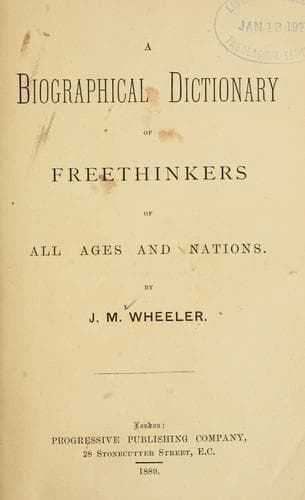
A Biographical Dictionary of Freethinkers of All Ages and Nations — John Shaqi
A Biographical Dictionary of Freethinkers of All Ages and NationsWheeler, J. M. (Joseph Mazzini)
Religion
A Biographical Dictionary of Freethinkers of All Ages and Nations
Wheeler, J. M. (Joseph Mazzini)
Free thought -- Biography
Avicenna (Husain Ibn Abdallah, called Ibn Sina), Arabian physician and
philosopher, b. Aug. 980 in the district of Bokhara. From his early
youth he was a wonderful student, and at his death 15 June, 1037,
he left behind him above a hundred treatises. He was the sovereign
authority in medical science until the days of Harvey. His philosophy
was pantheistic in tone, with an attempt at compromise with theology.
Aymon (Jean), French writer, b. Dauphiné 1661. Brought up in the
Church, he abjured Catholicism at Geneva, and married at the Hague. He
published Metamorphoses of the Romish Religion, and is said to have
put forward a version of the Esprit de Spinoza under the famous title
Treatise of Three Impostors. Died about 1734.
Bagehot (Walter), economist and journalist, b. of Unitarian parents,
Langport, Somersetshire, 3 Feb. 1826; he died at the same place 24
March, 1877. He was educated at London University, of which he became
a fellow. For the last seventeen years of his life he edited the
Economist newspaper. His best-known works are The English Constitution,
Lombard Street and Literary Studies. In Physics and Politics (1872),
a series of essays on the Evolution of Society, he applies Darwinism
to politics. Bagehot was a bold, clear, and very original thinker,
who rejected historic Christianity.
Baggesen (Jens Immanuel), Danish poet, b. Kösor, Zealand. 15
Feb. 1764. In 1789 he visited Germany, France, and Switzerland; at
Berne he married the grand-daughter of Haller. He wrote popular poems
both in Danish and German, among others Adam and Eve, a humorous mock
epic (1826). He was an admirer of Voltaire. Died Hamburg, 3 Oct. 1826.
Bahnsen (Julius Friedrich August), pessimist, b. Tondern,
Schleswig-Holstein, 30 Mar. 1830. Studied philosophy at Keil,
1847. He fought against the Danes in '49, and afterwards studied at
Tübingen. Bahnsen is an independent follower of Schopenhauer and
Hartmann, joining monism to the idealism of Hegel. He has written
several works, among which we mention The Philosophy of History,
Berlin, 1872, and The Contradiction between the Knowledge and the
Nature of the World (2 vols), Berlin 1880-82.
Bahrdt (Karl Friedrich), German deist, b. in Saxony, 25
Aug. 1741. Educated for the Church, in 1766 he was made professor
of biblical philology. He was condemned for heresy, and wandered
from place to place. He published a kind of expurgated Bible, called
New Revelations of God: A System of Moral Religion for Doubters and
Thinkers, Berlin, 1787, and a Catechism of Natural Religion, Halle,
1790. Died near Halle, 23 April, 1792.
Bailey (James Napier), Socialist, edited the Model Republic, 1843, the
Torch, and the Monthly Messenger. He published Gehenna: its Monarch
and Inhabitants; Sophistry Unmasked, and several other tracts in the
"Social Reformer's Cabinet Library," and some interesting Essays on
Miscellaneous Subjects, at Leeds, 1842.
Public-domain text, read in full here on John Shaqi.
Reviews
Reviews
No reviews yet
Be the first to share your thoughts on this work.
Join the Discussion
Join the discussion
Sign in to leave a comment or review.
Sign InorCreate an account