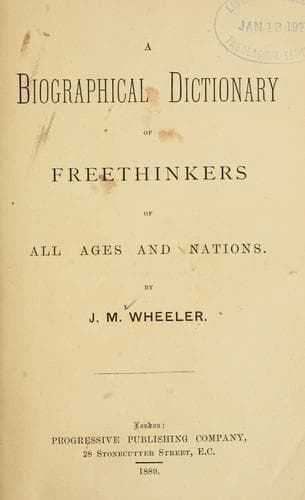
A Biographical Dictionary of Freethinkers of All Ages and NationsWheeler, J. M. (Joseph Mazzini)
Religion
A Biographical Dictionary of Freethinkers of All Ages and Nations
Wheeler, J. M. (Joseph Mazzini)
Free thought -- Biography
Montesquieu (Charles de Secondat), Baron, eminent French writer,
b. near Bordeaux, 18 Jan. 1689. His first literary performance was
entitled Persian Letters, 1721. In 1728 he was admitted a member of
the French Academy, though opposed by Cardinal Fleury on the ground
that his writings were dangerous to religion. His chief work is the
Spirit of Laws, 1748. This work was one of the first-fruits of the
positive spirit in history and jurisprudence. The chapters on Slavery
are written in a vein of masterly irony, which Voltaire pronounced
to be worthy of Molière. Died 10 Feb. 1755.
Montgomery (Edmund), Dr. philosopher, b. of Scotch parents, Edinburgh
1835. In youth he lived at Frankfort, where he saw Schopenhauer,
and afterwards attended at Heidelberg the lectures of Moleschott and
Kuno Fischer. He became a friend of Feuerbach. He wrote in German and
published at Munich in '71, The Kantian Theory of Knowledge refuted
from the Empirical Standpoint. In '67 he published a small book On
the Formation of so-called Cells in Animal Bodies. In '71 he went to
Texas and prosecuted his scientific studies on life. He has written
in the Popular Science Monthly, The Index, and The Open Court and
Mind. Dr. Montgomery holds not only that there is no evidence of a God,
but that there is evidence to the contrary.
Montgolfier (Michel Joseph), aeronaut, b. Aug. 1740. He was the first
to ascend in an air balloon, 5 June 1783. A friend of Delambre and
La Lalande, he was on the testimony of this last an atheist. Died 26
June 1810.
Mook (Friedrich) German writer, b. Bergzabern, 29 Sept. 1844, studied
philosophy and theology at Tübingen, but gave up the latter to study
medicine. He lived as a writer at Heidelberg and became lecturer to
a free congregation at Nürenburg, and wrote a popular Life of Jesus,
published at Zürich, '72-3. He travelled abroad and was drowned in
the river Jordan, 13 Dec. 1880. His brother Kurt, b. 12 Feb. 1847,
is a physician who has published some poems.
Moor (Edmund), Major in the East Indian Company, author of the Hindu
Pantheon, 1810 and Oriental Fragments, '34. Died 1840.
Moreau (Hégésippe), French poet, b. Paris 9, April 1810. A radical
and freethinker, he fought in the barricades in '30. Wrote songs and
satires of considerable merit, and a prose work entitled The Mistletoe
and the Oak. His life, which was a continual struggle with misery,
terminated in a hospital, 20 Dec. 1838. His works have been collected,
with an introduction by Sainte-Beuve.
Moreau (Jacques Joseph), Dr. of Tours, b. Montresor, 1804. He became a
distinguished alienist of the materialist school, and wrote on Moral
Faculties from a medical point of view, '36, and many physiological
works.
Morelly, French socialist of the eighteenth century,
b. Vitry-le-Français, author of a work called Code de la Nature,
sometimes attributed to Diderot. It was published in 1755, and urges
that man should find circumstances in which depravity is minimised.
Public-domain text, read in full here on John Shaqi.
Reviews
Reviews
No reviews yet
Be the first to share your thoughts on this work.
Elsewhere in the archive
Join the Discussion
Join the discussion
Sign in to leave a comment or review.
Sign InorCreate an account