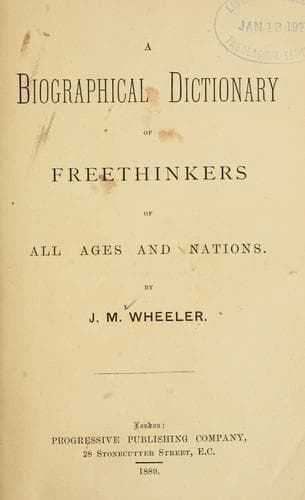
A Biographical Dictionary of Freethinkers of All Ages and NationsWheeler, J. M. (Joseph Mazzini)
Religion
A Biographical Dictionary of Freethinkers of All Ages and Nations
Wheeler, J. M. (Joseph Mazzini)
Free thought -- Biography
Bithell (Richard), Agnostic, b. Lewes, Sussex, 22 March 1821, of pious
parents. Became teacher of mathematics and chemistry. Is Ph.D. of
Gottingen and B.Sc. of London University. In '65 he entered the
service of the Rothschilds. Has written Creed of a Modern Agnostic,
1883; and Agnostic Problems, 1887.
Björnson (Björnstjerne), Norwegian writer, b. Quickne 8 Dec. 1832. His
father was a Lutheran clergyman. Has done much to create a national
literature for Norway. For his freethinking opinions he was obliged
to leave his country and reside in Paris. Many of his tales have been
translated into English. In 1882 Björnson published at Christiania,
with a short introduction, a resumé of C. B. Waite's History of the
Christian Religion, under the title of Whence come the Miracles of the
New Testament? This was the first attack upon dogmatic Christianity
published in Norway, and created much discussion. The following year
he published a translation of Colonel Ingersoll's article in the North
American Review upon the "Christian Religion," with a long preface,
in which he attacks the State Church and Monarchy. The translation
was entitled Think for Yourself. The first edition rapidly sold out
and a second one appeared. He has since, both in speech and writing,
repeatedly avowed his Freethought, and has had several controversies
with the clergy.
Blagosvyetlov (Grigorevich E.), Russian author, b. in the Caucasus,
1826. Has written on Shelley, Buckle, and Mill, whose Subjection
of Women he translated into Russian. He edited a magazine Djelo
(Cause). Died about 1885.
Blanqui (Louis Auguste), French politician, b. near Nice, 7 Feb. 1805,
a younger brother of Jerome Adolphe Blanqui, the economist. Becoming
a Communist, his life was spent in conspiracy and imprisonment
under successive governments. In '39 he was condemned to death, but
his sentence commuted to imprisonment for life, and was subject to
brutal treatment till the revolution of '48 set him at liberty. He
was soon again imprisoned. In '65 he wrote some remarkable articles
on Monotheism in Le Candide. After the revolution of 4 Sept. '70,
Blanqui demanded the suppression of worship. He was again imprisoned,
but was liberated and elected member of the Commune, and arrested by
Thiers. In his last imprisonment he wrote a curious book, Eternity
and the Stars, in which he argues from the eternity and infinity of
matter. Died Paris, 31 Dec. 1880. Blanqui took as his motto "Ni Dieu
ni maître"--Neither God nor master.
Blasche (Bernhard Heinrich), German Pantheist, b. Jena 9 April,
1776. His father was a professor of theology and philosophy. He wrote
Kritik des Modernen Geisterglaubens (Criticism of Modern Ghost Belief),
Philosophische Unsterblichkeitslehre (Teaching of Philosophical
Immortality), and other works. Died near Gotha 26 Nov. 1832.
Public-domain text, read in full here on John Shaqi.
Reviews
Reviews
No reviews yet
Be the first to share your thoughts on this work.
Join the Discussion
Join the discussion
Sign in to leave a comment or review.
Sign InorCreate an account