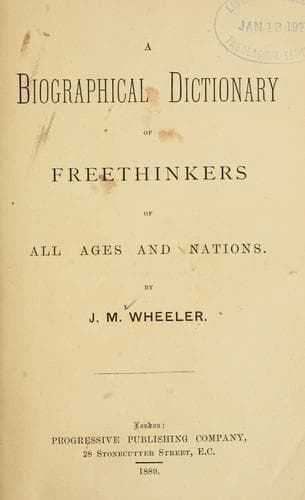
A Biographical Dictionary of Freethinkers of All Ages and NationsWheeler, J. M. (Joseph Mazzini)
Religion
A Biographical Dictionary of Freethinkers of All Ages and Nations
Wheeler, J. M. (Joseph Mazzini)
Free thought -- Biography
Blignieres (Célestin de), French Positivist, of the Polytechnic
school. Has written a popular exposition of Positive philosophy and
religion, Paris 1857; The Positive Doctrine, 1867; Studies of Positive
Morality, 1868; and other works.
Blind (Karl), German Republican, b. Mannheim, 4 Sept. 1826. Studied
at Heidelberg and Bonn. In 1848 he became a revolutionary leader
among the students and populace, was wounded at Frankfort, and
proscribed. In Sept. '48 he led the second republican revolution in
the Black Forest. He was made prisoner and sentenced to eight year's
imprisonment. In the spring of '49 he was liberated by the people
breaking open his prison. Being sent on a mission to Louis Napoleon,
then president of the French Republic at Paris, he was arrested and
banished from France. He went to Brussels, but since '52 has lived
in in England, where he has written largely on politics, history,
and mythology. His daughter Mathilde, b. at Mannheim, opened her
literary career by publishing a volume of poems in 1867 under the
name of Claude Lake. She has since translated Straus's Old Faith and
the New, and written the volumes on George Eliot and Madame Roland
in the Eminent Women series.
Blount (Charles), English Deist of noble family, b. at Holloway 27
April, 1654. His father, Sir Henry Blount, probably shared in his
opinions, and helped him in his anti-religious work, Anima Mundi,
1678. This work Bishop Compton desired to see suppressed. In 1680 he
published Great is Diana of the Ephesians, or the Origin of Idolatry,
and the two first books of Apollonius Tyanius, with notes, in which
he attacks priestcraft and superstition. This work was condemned and
suppressed. Blount also published The Oracles of Reason, a number
of Freethought Essays. By his Vindication of Learning and Liberty
of the Press, and still more by his hoax on Bohun entitled William
and Mary Conquerors, he was largely instrumental in doing away with
the censorship of the press. He shot himself, it is said, because
he could not marry his deceased wife's sister (August, 1693). His
miscellaneous works were printed in one volume, 1695.
Blumenfeld (J. C.), wrote The New Ecce Homo or the Self Redemption of
Man, 1839. He is also credited with the authorship of The Existence of
Christ Disproved in a series of Letters by "A German Jew," London,
1841.
Boerne (Ludwig), German man of letters and politician, b. Frankfort
22 May, 1786. In 1818 he gave up the Jewish religion, in which he had
been bred, nominally for Protestantism, but really he had, like his
friend Heine, become a Freethinker. He wrote many works in favor of
political liberty and translated Lammenais' Paroles d'un Croyant. Died
12 Feb. 1837.
Public-domain text, read in full here on John Shaqi.
Reviews
Reviews
No reviews yet
Be the first to share your thoughts on this work.
Join the Discussion
Join the discussion
Sign in to leave a comment or review.
Sign InorCreate an account