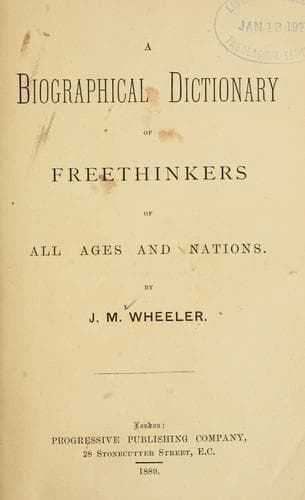
A Biographical Dictionary of Freethinkers of All Ages and Nations — John Shaqi
A Biographical Dictionary of Freethinkers of All Ages and NationsWheeler, J. M. (Joseph Mazzini)
Religion
A Biographical Dictionary of Freethinkers of All Ages and Nations
Wheeler, J. M. (Joseph Mazzini)
Free thought -- Biography
Abbot (Francis Ellingwood). American Freethinker, b. Boston, 6
Nov. 1836. He graduated at Harvard University 1859, began life as a
Unitarian minister, but becoming too broad for that Church, resigned
in 1869. He started the Index, a journal of free religious inquiry
and anti-supernaturalism, at Toledo, but since 1874 at Boston. This he
edited 1870-80. In 1872 appeared his Impeachment of Christianity. In
addition to his work on the Index, Mr. Abbot has lectured a great
deal, and has contributed to the North American Review and other
periodicals. He was the first president of the American National
Liberal League. Mr. Abbot is an evolutionist and Theist, and defends
his views in Scientific Theism, 1886.
Ablaing van Giessenburg (R.C.) See Giessenburg.
Abu Bakr Ibn Al-Tufail (Abu J'afar) Al Isbili. Spanish Arabian
philosopher, b. at Guadys, wrote a philosophical romance of pantheistic
tendency Hai Ibn Yakdan, translated into Latin by Pocock, Oxford 1671,
and into English by S. Ockley, 1711, under the title of The Improvement
of Human Reason. Died at Morocco 1185.
Abu-Fazil (Abu al Fadhl ibn Mubarak, called Al Hindi), vizier to
the great Emperor Akbar from 1572. Although by birth a Muhammadan,
his investigations into the religions of India made him see equal
worth in all, and, like his master, Akbar, he was tolerant of all
sects. His chief work is the Ayin Akbary, a statistical account of
the Indian Empire. It was translated by F. Gladwin, 1777. He was
assassinated 1604.
Abul-Abbas-Abdallah III. (Al Mamoun), the seventh Abbasside, caliph,
son of Haroun al Rashid, was b. at Bagdad 16 Sept. 786. He was a patron
of science and literature, collected Greek and Hebrew manuscripts,
and invited the scholars of all nations to his capital. He wrote
several treatises and poems. Died in war near Tarsus, 9 Aug. 833.
Abul-Ola (Ahmad ibn Abd Allah ibn Sulaiman), celebrated Arabian poet,
b. at Maari, in Syria, Dec., 973. His free opinions gave much scandal
to devout Moslems. He was blind through small-pox from the age of
four years, but his poems exhibit much knowledge. He called himself
"the doubly imprisoned captive," in allusion to his seclusion and
loss of sight. He took no pains to conceal that he believed in no
revealed religion. Died May, 1057, and ordered the following verse
to be written on his tomb:--"I owe this to the fault of my father:
none owe the like to mine."
Abu Tahir (al Karmatti), the chief of a freethinking sect at Bahrein,
on the Persian Gulf, who with a comparatively small number of followers
captured Mecca (930), and took away the black stone. He suddenly
attacked, defeated, and took prisoner Abissaj whom, at the head of
thirty thousand men, the caliph had sent against him. Died in 943.
Achillini (Alessandro), Italian physician and philosopher b. Bologna 29
Oct. 1463. He expounded the doctrines of Averroes, and wrote largely
upon anatomy. Died 2 Aug. 1512. His collected works were published
at Venice, 1545.
Public-domain text, read in full here on John Shaqi.
Reviews
Reviews
No reviews yet
Be the first to share your thoughts on this work.
Join the Discussion
Join the discussion
Sign in to leave a comment or review.
Sign InorCreate an account