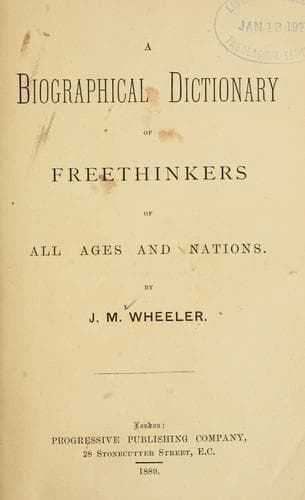
A Biographical Dictionary of Freethinkers of All Ages and Nations — John Shaqi
A Biographical Dictionary of Freethinkers of All Ages and NationsWheeler, J. M. (Joseph Mazzini)
Religion
A Biographical Dictionary of Freethinkers of All Ages and Nations
Wheeler, J. M. (Joseph Mazzini)
Free thought -- Biography
Ackermann (Louise-Victorine, née Choquet), French poetess, b. Paris 30
Nov. 1813. She travelled to Germany and there married (1853) a young
theologian, Paul Ackerman, who in preparing for the ministry lost his
Christian faith, and who, after becoming teacher to Prince Frederick
William (afterwards Frederick III.), died at the age of thirty-four
(1846). Both were friends of Proudhon. Madame Ackermann's poems
(Paris 1863-74 and 85) exhibit her as a philosophic pessimist and
Atheist. "God is dethroned," says M. Caro of her poems (Revue des
Deux Mondes, 15 May, 1874). She professes hatred of Christianity
and its interested professors. She has also published Thoughts of a
Solitary. Sainte Beuve calls her "the learned solitary of Nice."
Acollas (Pierre Antoine René Paul Emile), French jurisconsult and
political writer, b. La Châtre 25 June, 1826, studied law at Paris. For
participating in the Geneva congress of the International Society
in 1867 he was condemned to one year's imprisonment. In 1871 he was
appointed head of the law faculty by the Commune. He has published
several manuals popularising the legal rights of the people, and has
written on Marriage its Past, Present, and Future, 1880. Mrs. Besant
has translated his monograph on The Idea of God in the Revolution,
published in the Droits de l'Homme.
Acontius (Jacobus--Italian, Giacomo Aconzio). Born at Trent early
in sixteenth century. After receiving ordination in the Church of
Rome he relinquished that faith and fled to Switzerland in 1557. He
subsequently came to England and served Queen Elizabeth as a military
engineer. To her he dedicated his Strategems of Satan, published at
Basle 1565. This was one of the earliest latitudinarian works, and
was placed upon the Index. It was also bitterly assailed by Protestant
divines, both in England and on the Continent. An English translation
appeared in 1648. Some proceedings were taken against Acontius before
Bishop Grindall, of the result of which no account is given. Some
passages of Milton's Areopagitica may be traced to Acontius, who,
Cheynell informs us, lived till 1623. Stephen's Dictionary of National
Biography says he is believed to have died shortly after 1566.
Acosta (Uriel). Born at Oporto 1597, the son of a Christianised Jew;
he was brought up as a Christian, but on reaching maturity, rejected
that faith. He went to Holland, where he published a work equally
criticising Moses and Jesus. For this he was excommunicated by the
Synagogue, fined and put in prison by the Amsterdam authorities,
and his work suppressed. After suffering many indignities from both
Jews and Christians, he committed suicide 1647.
Adams (George), of Bristol, sentenced in 1842 to one month's
imprisonment for selling the Oracle of Reason.
Adams (Robert C.), Canadian Freethought writer and lecturer. Author
of Travels in Faith from Tradition to Reason (New York, 1884), also
Evolution, a Summary of Evidence.
Public-domain text, read in full here on John Shaqi.
Reviews
Reviews
No reviews yet
Be the first to share your thoughts on this work.
Join the Discussion
Join the discussion
Sign in to leave a comment or review.
Sign InorCreate an account