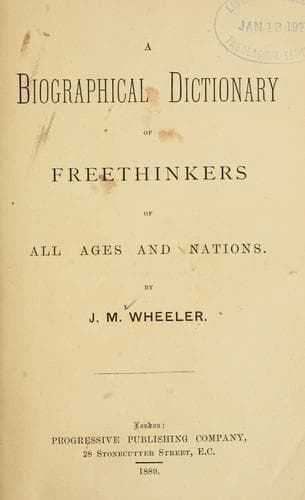
A Biographical Dictionary of Freethinkers of All Ages and NationsWheeler, J. M. (Joseph Mazzini)
Religion
A Biographical Dictionary of Freethinkers of All Ages and Nations
Wheeler, J. M. (Joseph Mazzini)
Free thought -- Biography
Clifford (William Kingdon), mathematician, philosopher, and moralist,
of rare originality and boldness, b. Exeter 4 May, 1845. At the age
of fifteen he was sent to King's College, London, where he showed an
early genius for mathematics, publishing the Analogues of Pascal's
Theorem at the age of eighteen. Entered Trinity College, Cambridge,
in '63. In '67 he was second wrangler. Elected fellow of his college,
he remained at Cambridge till 1870, when he accompanied the eclipse
expedition to the Mediterranean. The next year he was appointed
Professor of mathematics at London University, a post he held till
his death. He was chosen F.R.S. '74. Married Miss Lucy Lane in April,
'75. In the following year symptoms of consumption appeared, and he
visited Algeria and Spain. He resumed work, but in '79 took a voyage to
Madeira, where he died 3 March. Not long before his death appeared the
first volume of his great mathematical work, Elements of Dynamic. Since
his death have been published The Common Sense of the Exact Sciences,
and Lectures and Essays, in two volumes, edited by Leslie Stephen and
Mr. F. Pollock. These volumes include his most striking Freethought
lectures and contributions to the Fortnightly and other reviews. He
intended to form them into a volume on The Creed of Science. Clifford
was an outspoken Atheist, and he wrote of Christianity as a religion
which wrecked one civilisation and very nearly wrecked another.
Cloots or Clootz (Johann Baptist, afterwards Anacharsis) Baron du Val
de Grâce, Prussian enthusiast, b. near Cleves, 24 June, 1755, was a
nephew of Cornelius de Pauw. In 1780 he published the The Certainty
of the Proofs of Mohammedanism, under the pseudonym of Ali-gier-ber,
an anagram of Bergier, whose Certainty of the Proofs of Christianity
he parodies. He travelled widely, but became a resident of Paris
and a warm partisan of the Revolution, to which he devoted his large
fortune. He wrote a reply to Burke, and continually wrote and spoke
in favor of a Universal Republic. On 19 June, 1790, he, at the head
of men of all countries, asked a place at the feast of Federation,
and henceforward was styled "orator of the human race." He was, with
Paine, Priestley, Washington and Klopstock, made a French citizen,
and in 1792 was elected to the Convention by two departments. He
debaptised himself, taking the name Anacharsis, was a prime mover
in the Anti-Catholic party, and induced Bishop Gobel to resign. He
declared there was no other God but Nature. Incurring the enmity of
Robespierre, he and Paine were arrested as foreigners. After two
and a half months' imprisonment at St. Lazare, he was brought to
the scaffold with the Hébertistes, 24 March, 1794. He died calmly,
uttering materialist sentiments to the last.
Public-domain text, read in full here on John Shaqi.
Reviews
Reviews
No reviews yet
Be the first to share your thoughts on this work.
Elsewhere in the archive
Join the Discussion
Join the discussion
Sign in to leave a comment or review.
Sign InorCreate an account