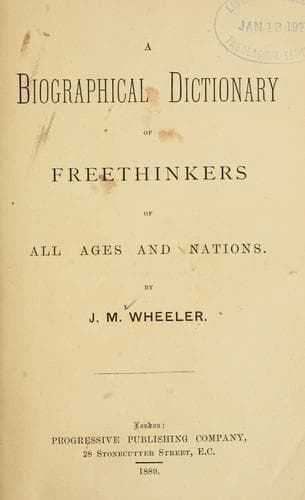
A Biographical Dictionary of Freethinkers of All Ages and NationsWheeler, J. M. (Joseph Mazzini)
Religion
A Biographical Dictionary of Freethinkers of All Ages and Nations
Wheeler, J. M. (Joseph Mazzini)
Free thought -- Biography
Collins (Anthony), English Deist, b. Heston, Middlesex, 21 June,
1676. He studied at Cambridge and afterwards at the Temple, and
became Justice of the Peace and Treasurer of the County of Essex. He
was an intimate friend of Locke, who highly esteemed him and made
him his executor. He wrote an Essay on Reason, 1707; Priestcraft
in Perfection, 1710; a Vindication of the Divine Attributes, and a
Discourse on Freethinking, 1713. This last occasioned a great outcry,
as it argued that all belief must be based on free inquiry, and
that the use of reason would involve the abandonment of supernatural
revelation. In 1719 he published An Inquiry Concerning Human Liberty,
a brief, pithy defence of necessitarianism, and in 1729 A Discourse
on Liberty and Necessity. In 1724 appeared his Discourse on the
Grounds and Reasons of the Christian Religion, and this was followed
by The Scheme of Literal Prophecy Considered, 1726. He was a skilful
disputant, and wrote with great ability. He is also credited with A
Discourse Concerning Ridicule and Irony in Writing. Died at London,
13 Dec. 1729. Collins, says Mr. Leslie Stephen, "appears to have been
an amiable and upright man, and to have made all readers welcome to
the use of a free library." Professor Fraser calls him "a remarkable
man," praises his "love of truth and moral courage," and allows that in
answering Dr. Samuel Clarke on the question of liberty and necessity
he "states the arguments against human freedom with a logical force
unsurpassed by any necessitarian." A similar testimony to Collins as
a thinker and dialectician is borne by Professor Huxley.
Colman (Lucy N.), American reformer, b. 26 July, 1817, has spent
most of her life advocating the abolition of slavery, women's rights,
and Freethought. She has lectured widely, written Reminisences in the
Life of a Reformer of Fifty Years, and contributed to the Truthseeker
and Boston Investigator.
Colotes, of Lampsacus, a hearer and disciple of Epicurus, with whom he
was a favorite. He wrote a work in favor of his master's teachings. He
held it was unworthy of a philosopher to use fables.
Combe (Abram), one of a noted Scotch family of seventeen, b. Edinburgh,
15 Jan. 1785. He traded as a tanner, but, becoming acquainted with
Robert Owen, founded a community at Orbiston upon the principle of
Owen's New Lanark, devoting nearly the whole of his large fortune
to the scheme. But his health gave way and he died 11 Aug. 1827. He
wrote Metaphysical Sketches of the Old and New Systems and other
works advocating Owenism.
Combe (Andrew), physician, brother of the above, b. Edinburgh,
27 Oct. 1797; studied there and in Paris; aided his brother George
in founding the Phrenological Society; wrote popular works on the
Principles of Physiology and the Management of Infancy. Died near
Edinburgh, 9 Aug. 1847.
Public-domain text, read in full here on John Shaqi.
Reviews
Reviews
No reviews yet
Be the first to share your thoughts on this work.
Elsewhere in the archive
Join the Discussion
Join the discussion
Sign in to leave a comment or review.
Sign InorCreate an account