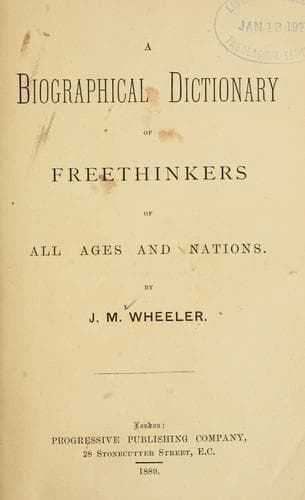
A Biographical Dictionary of Freethinkers of All Ages and NationsWheeler, J. M. (Joseph Mazzini)
Religion
A Biographical Dictionary of Freethinkers of All Ages and Nations
Wheeler, J. M. (Joseph Mazzini)
Free thought -- Biography
Combe (George), phrenologist and educationalist, b. Edinburgh,
21 Oct. 1788. He was educated for the law. Became acquainted with
Spurzheim, and published Essays on Phrenology, 1819, and founded the
Phrenological Journal. In '28 he published the Constitution of Man,
which excited great controversy especially for removing the chimeras of
special providence and efficacy of prayer. In '33 he married a daughter
of Mrs. Siddons. He visited the United States and lectured on Moral
Philosophy and Secular Education. His last work was The Relations
between Science and Religion, '57, in which he continued to uphold
Secular Theism. He also published many lectures and essays. Among his
friends were Miss Evans (George Eliot), who spent a fortnight with him
in '52. He did more than any man of his time, save Robert Owen, for the
cause of Secular education. Died at Moor Park, Surrey, 14 Aug. 1858.
Combes (Paul), French writer, b. Paris, 13 June, 1856. Has written
on Darwinism, '83, and other works popularising science.
Commazzi (Gian-Battista), Count author of Politica e religione trovate
insieme nella persona di Giesù Cristo, Nicopoli [Vienna] 4 vols.,
1706-7, in which he makes Jesus to be a political impostor. It was
rigorously confiscated at Rome and Vienna.
Comparetti (Domenico), Italian philologist, b. Rome in 1835. Signor
Comparetti is Professor at the Institute of Superior Studies, Rome,
and has written many works on the classic writers, in which he evinces
his Pagan partialities.
Comte (Isidore Auguste Marie François Xavier), French philosopher,
mathematician and reformer, b. at Montpelier, 12 Jan. 1798. Educated at
Paris in the Polytechnic School, where he distinguished himself by his
mathematical talent. In 1817 he made the acquaintance of St. Simon,
agreeing with him as to the necessity of a Social renovation based
upon a mental revolution. On the death of St. Simon ('25) Comte
devoted himself to the elaboration of an original system of scientific
thought, which, in the opinion of some able judges, entitles him to
be called the Bacon of the nineteenth century. Mill speaks of him as
the superior of Descartes and Leibniz. In '25 he married, but the
union proved unhappy. In the following year he lectured, but broke
down under an attack of brain fever, which occasioned his detention
in an asylum. He speedily recovered, and in '28 resumed his lectures,
which were attended by men like Humboldt, Ducrotay, Broussais, Carnot,
etc. In '30 he put forward the first volumes of his Course of Positive
Philosophy, which in '42 was completed by the publication of the sixth
volume. A condensed English version of this work was made by Harriet
Martineau, '53. In '45 Comte formed a passionate Platonic attachement
to Mme. Clotilde de Vaux, who died in the following year, having
profoundely influenced Comte's life. In consequence of his opinions,
he lost his professorship, and was supported by his disciples--Mill,
Molesworth and Grote, in England, assisting.
Public-domain text, read in full here on John Shaqi.
Reviews
Reviews
No reviews yet
Be the first to share your thoughts on this work.
Elsewhere in the archive
Join the Discussion
Join the discussion
Sign in to leave a comment or review.
Sign InorCreate an account