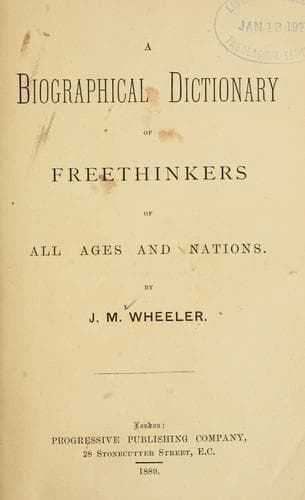
A Biographical Dictionary of Freethinkers of All Ages and NationsWheeler, J. M. (Joseph Mazzini)
Religion
A Biographical Dictionary of Freethinkers of All Ages and Nations
Wheeler, J. M. (Joseph Mazzini)
Free thought -- Biography
Alfieri (Vittorio), Count. Famous Italian poet and dramatist, b. Asti,
Piedmont, 17 Jan. 1749, of a noble family. His tragedies are justly
celebrated, and in his Essay on Tyranny he shows himself as favorable
to religious as to political liberty. Written in his youth, this work
was revised at a more advanced age, the author remarking that if he
had no longer the courage, or rather the fire, necessary to compose
it, he nevertheless retained intelligence, independence and judgment
enough to approve it, and to let it stand as the last of his literary
productions. His attack is chiefly directed against Catholicism,
but he does not spare Christianity. "Born among a people," he says,
"slavish, ignorant, and already entirely subjugated by priests, the
Christian religion knows only how to enjoin the blindest obedience,
and is unacquainted even with the name of liberty." Alfieri's tragedy
of Saul has been prohibited on the English stage. Died Florence,
8 Oct. 1803.
Alfonso X., surnamed the Wise, King of Castillo and of Leon; b. in
1223, crowned 1252. A patron of science and lover of astronomy. He
compiled a complete digest of Roman, feudal and canon law, and
had drawn up the astronomical tables called Alfonsine Tables. By
his liberality and example he gave a great impulse to Spanish
literature. For his intercourse with Jews and Arabians, his
independence towards the Pope and his free disposal of the clerical
revenues, he has been stigmatised as an Atheist. To him is attributed
the well-known remark that had he been present at the creation of the
world he would have proposed some improvements. Father Lenfant adds
the pious lie that "The king had scarcely pronounced this blasphemy
when a thunderbolt fell and reduced his wife and two children to
ashes." Alfonso X. died 4 April, 1284.
Algarotti (Francesco), Count. Italian writer and art critic, b. at
Venice, 11 Dec. 1712. A visit to England led him to write Newtonianism
for the Ladies. He afterwards visited Berlin and became the friend
both of Voltaire and of Frederick the Great, who appointed him his
Chamberlain. Died with philosophical composure at Pisa, 3 May, 1764.
Alger (William Rounseville), b. at Freetown, Massachusetts, 30
Dec. 1822, educated at Harvard, became a Unitarian preacher of the
advanced type. His Critical History of the Doctrine of a Future
Life, with a complete bibliography of the subject by Ezra Abbot,
is a standard work, written from the Universalist point of view.
Public-domain text, read in full here on John Shaqi.
Reviews
Reviews
No reviews yet
Be the first to share your thoughts on this work.
Join the Discussion
Join the discussion
Sign in to leave a comment or review.
Sign InorCreate an account