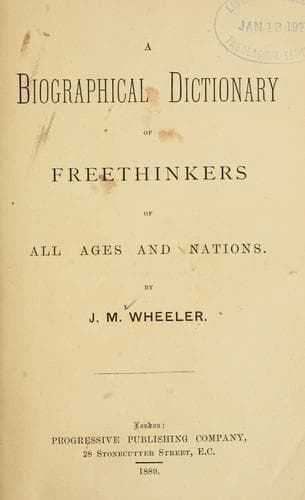
A Biographical Dictionary of Freethinkers of All Ages and Nations — John Shaqi
A Biographical Dictionary of Freethinkers of All Ages and NationsWheeler, J. M. (Joseph Mazzini)
Religion
A Biographical Dictionary of Freethinkers of All Ages and Nations
Wheeler, J. M. (Joseph Mazzini)
Free thought -- Biography
Alciati (Giovanni Paolo). A Milanese of noble family. At first
a Romanist, he resigned that faith for Calvinism, but gradually
advanced to Anti-trinitarianism, which he defends in two letters
to Gregorio Pauli, dated Austerlitz 1564 and 1565. Beza says that
Alciati deserted the Christian faith and became a Muhammadan, but
Bayle takes pains to disprove this. Died at Dantzic about 1570.
Aleardi (Gaetano). Italian poet, known as Aleardo Aleardi, b. Verona, 4
Nov. 1812. He was engaged in a life-long struggle against the Austrian
dominion, and his patriotic poems were much admired. In 1859 he was
elected deputy to Parliament for Brescia. Died Verona, 16 July, 1878.
Alembert (Jean le Rond d'), mathematician and philosopher, b. at
Paris 16 Nov. 1717. He was an illegitimate son of Canon Destouches
and Mme. Tencin, and received his Christian name from a church
near which he was exposed as a foundling. He afterwards resided
for forty years with his nurse, nor would he leave her for the most
tempting offers. In 1741, he was admitted a member of the Academy of
Sciences. In 1749, he obtained the prize medal from the Academy of
Berlin, for a discourse on the theory of winds. In 1749, he solved the
problem of the procession of the equinoxes and explained the mutation
of the earth's axis. He next engaged with Diderot, with whose opinions
he was in complete accord, in compiling the famous Encyclopédie, for
which he wrote the preliminary discourse. In addition to this great
work he published many historical, philosophical and scientific essays,
and largely corresponded with Voltaire. His work on the Destruction
of the Jesuits is a caustic and far-reaching production. In a letter
to Frederick the Great, he says: "As for the existence of a supreme
intelligence, I think that those who deny it advance more than they
can prove, and scepticism is the only reasonable course." He goes on
to say, however, that experience invincibly proves the materiality of
the "soul." Died 29 Oct. 1783. In 1799 two volumes of his posthumous
essays were printed in Paris. His works prove d'Alembert to have been
of broad spirit and of most extensive knowledge.
Public-domain text, read in full here on John Shaqi.
Reviews
Reviews
No reviews yet
Be the first to share your thoughts on this work.
Join the Discussion
Join the discussion
Sign in to leave a comment or review.
Sign InorCreate an account