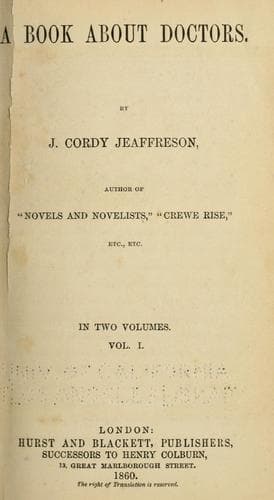
Medicine -- Anecdotes; Physicians -- Great Britain
proceedings." The only art which fashionable people now-a-days care
much to meddle with is literature. In estimating the difference
between the position of an eminent surgeon now, and that which he
would have occupied in earlier times, we must remember that life and
hereditary knighthood are the highest dignities to which he is now
permitted to aspire; although since this honour was first accorded to
him it has so fallen in public estimation, that it has almost ceased
to be an honour at all. It can scarcely be questioned that if Sir
Benjamin Brodie were to be elevated to the rank of a Baron of the
realm, he would still not occupy a better position, in regard to the
rest of society, than that which Sir William Butts and Sir John
Ayliffe did after they were knighted. A fact that definitely fixes the
high esteem in which Edward III. held his medical officers, is one of
his grants--"Quod Willielmus Holme Sirurgicus Regis pro vitâ suâ
possit, fugare, capere, et asportare omnimodas feras in quibuscunque
forestis, chaccis parcis et warrennis regis." Indeed, at a time when
the highest dignitaries of the Church, the proudest bishops and the
wealthiest abbots, practised as physicians, it followed, as a matter
of course, that everything pertaining to their profession was
respected.
From remote antiquity the fee of the healer has been regarded as a
voluntary offering for services gratuitously rendered. The pretender
to the art always stuck out for a price, and in some form or other
made the demand which was imprinted on the pillboxes of Lilly's
successor, John Case,
"Here's fourteen pills for thirteen pence,
Enough in any man's own con-sci-ence."
But the true physician always left his reward to be measured by the
gratitude and justice of the benefited. He extorted nothing, but
freely received that which was freely given. Dr. Doran, with his
characteristic erudition, says, "Now there is a religious reason why
fees are supposed not to be taken by physicians. Amongst the Christian
martyrs are reckoned the two eastern brothers, Damian and Cosmas. They
practised as physicians in Cilicia, and they were the first mortal
practitioners who refused to take recompense for their work. Hence
they were called Anargyri, or 'without money.' All physicians are
pleasantly supposed to follow this example. They never take fees, like
Damian and Cosmas; but they meekly receive what they know will be
given out of Christian humility, and with a certain or uncertain
reluctance, which is the nearest approach that can be made in these
times to the two brothers who were in partnership at Egea in Cilicia."
Public-domain text, read in full here on John Shaqi.
Reviews
Reviews
No reviews yet
Be the first to share your thoughts on this work.
Elsewhere in the archive
Join the Discussion
Join the discussion
Sign in to leave a comment or review.
Sign InorCreate an account