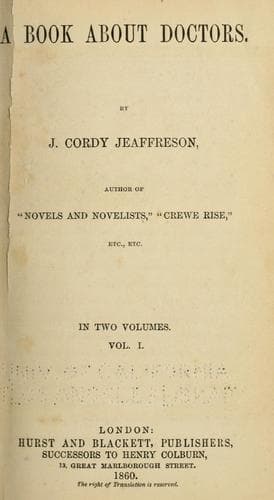
Medicine -- Anecdotes; Physicians -- Great Britain
But, with all due respect to our learned writer, there is a much
better reason for the phenomenon. Self-interest, and not a Christian
ambition to resemble the charitable Cilician brothers, was the cause
of physicians preferring a system of gratuities to a system of legal
rights. They could scarcely have put in _a claim_ without defining the
_amount claimed_; and they soon discovered that a rich patient, left
to his generosity, folly, and impotent anxiety to propitiate the
mysterious functionary who presided over his life, would, in a great
majority of cases, give ten, or even a hundred times as much as they
in the wildest audacity of avarice would ever dare to ask for.
Seleucus, for having his son Antiochus restored to health, was fool
enough to give sixty thousand crowns to Erasistratus: and for their
attendance on the Emperor Augustus, and his two next successors, no
less than four physicians received annual pensions of two hundred and
fifty thousand sesterces apiece. Indeed, there is no saying what a
sick man will not give his doctor. The "cacoethes donandi" is a
manifestation of enfeebled powers which a high-minded physician is
often called upon to resist, and an unprincipled one often basely
turns to his advantage. Alluding to this feature of the sick, a
deservedly successful and honourable practitioner, using the language
of one of our Oriental pro-consuls, said with a laugh to the writer of
these pages, "I wonder at my moderation."
But directly health approaches, this desirable frame of mind
disappears. When the devil was sick he was a very different character
from what he was on getting well. 'Tis so with ordinary patients, not
less than satanic ones. The man who, when he is in his agonies, gives
his medical attendant double fees three times a day (and vows, please
God he recover, to make his fortune by trumpeting his praises to the
world), on becoming convalescent, grows irritable, suspicious, and
distant,--and by the time he can resume his customary occupations,
looks on his dear benefactor and saviour as a designing rascal, bent
on plundering him of his worldly possessions. Euricus Cordus, who died
in 1535, seems to have taken the worst possible time for getting his
payment; but it cannot be regretted that he did so, as his experiences
inspired him to write the following excellent epigram:--
"Tres medicus facies habet; unam quando rogatur,
Angelicam; mox est, cum juvat, ipse Deus.
Post ubi curato, poscit sua prœmia, morbo,
Horridus apparet, terribilisque Sathan."
"Three faces wears the doctor: when first sought,
An angel's--and a God's the cure half wrought:
But when, that cure complete, he seeks his fee,
The Devil looks then less terrible than he."
Illustrative of the same truth is a story told of Bouvart. On entering
one morning the chamber of a French Marquis, whom he had attended
through a very dangerous illness, he was accosted by his noble patient
in the following terms:--
Public-domain text, read in full here on John Shaqi.
Reviews
Reviews
No reviews yet
Be the first to share your thoughts on this work.
Elsewhere in the archive
Join the Discussion
Join the discussion
Sign in to leave a comment or review.
Sign InorCreate an account