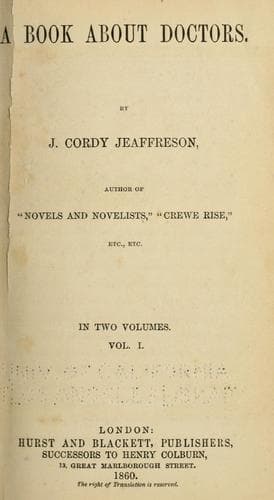
Medicine -- Anecdotes; Physicians -- Great Britain
Properly treated and fully expanded, this subject of "the stick" would
cover all the races of man in all regions and all ages; indeed, it
would hide every member of the human family. Attention could be called
to the respect accorded in every chapter of the world's history,
sacred and profane, to the _rabdos_--to the fasces of the Roman
lictors, which every school-boy honours (often unconsciously) with an
allusion when he says he will _lick_, or vows he won't be
_licked_,--to the herald's staff of Hermes, the caduceus of Mercury,
the wand of Æsculapius, and the rods of Moses and the contending
sorcerers--to the mystic bundles of nine twigs, in honour of the nine
muses, that Dr. Busby loved to wield, and which many a simple English
parent believes Solomon, in all his glory, recommended as an element
in domestic jurisdiction--to the sacred wands of savage tribes, the
staffs of our constables and sheriffs, and the highly polished gold
sticks and black rods that hover about the anterooms of St. James's or
Portsoken. The rule of thumb has been said to be the government of
this world. And what is this thumb but a short stick, a _sceptre_,
emblematic of a sovereign authority which none dares to dispute? "The
stick," says the Egyptian proverb, "came down from heaven."
The only sticks, however, that we here care to speak about are
physicians' canes, barbers' poles, and the twigs of rue which are
still strewn before the prisoner in the dock of a criminal court. Why
should they be thus strung together?
Public-domain text, read in full here on John Shaqi.
Reviews
Reviews
No reviews yet
Be the first to share your thoughts on this work.
Join the Discussion
Join the discussion
Sign in to leave a comment or review.
Sign InorCreate an account