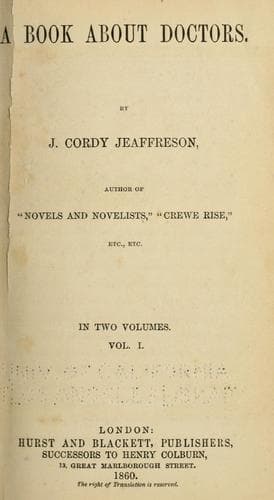
Medicine -- Anecdotes; Physicians -- Great Britain
The physician's cane is a very ancient part of his insignia. It is now
disused, but up to very recent times no doctor of medicine presumed to
pay a professional visit, or even to be seen in public, without this
mystic wand. Long as a footman's stick, smooth and varnished, with a
heavy gold knob or cross-bar at the top, it was an instrument with
which, down to the present century, every prudent aspirant to medical
practice was provided. The celebrated "gold-headed cane" which
Radcliffe, Mead, Askew, Pitcairn and Baillie successively bore is
preserved in the College of Physicians, bearing the arms which those
gentlemen assumed, or were entitled to. In one respect it deviated
from the physician's cane proper. It has a cross-bar almost like a
crook; whereas a physician's wand ought to have a knob at the top.
This knob in olden times was hollow, and contained a vinaigrette,
which the man of science always held to his nose when he approached a
sick person, so that its fumes might protect him from the noxious
exhalations of his patient. We know timid people who, on the same
plan, have their handkerchiefs washed in camphor-water, and bury their
faces in them whenever they pass the corner of a dingy street, or
cross an open drain, or come in contact with an ill-looking man. When
Howard, the philanthropist, visited Exeter, he found that the medical
officer of the county gaol had caused a clause to be inserted in his
agreement with the magistrates, exonerating him from attendance and
services during any outbreak of the gaol fever. Most likely this
gentleman, by books or experience, had been enlightened as to the
inefficacy of the vinaigrette.
Public-domain text, read in full here on John Shaqi.
Reviews
Reviews
No reviews yet
Be the first to share your thoughts on this work.
Join the Discussion
Join the discussion
Sign in to leave a comment or review.
Sign InorCreate an account