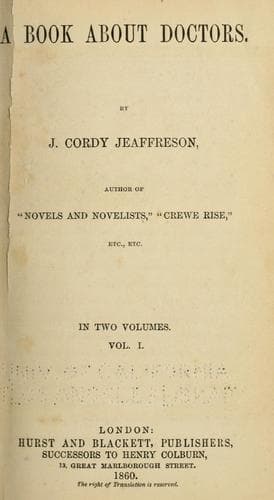
Medicine -- Anecdotes; Physicians -- Great Britain
"Sir Hans, in the decline of his life, left London and retired to his
manor-house, at Chelsea, where he resided about fourteen years before
he died. After his retirement at Chelsea, he requested it as a favour
to him (though I embraced it as an honour due to myself), that I would
visit him every week, in order to divert him for an hour or two with
the common news of the town, and with everything particular that
should happen amongst his acquaintance of the Royal Society, and other
ingenious gentlemen, many of whom I was weekly conversant with; and I
seldom missed drinking coffee with him on a Saturday, during the whole
time of his retirement at Chelsea. He was so infirm as to be wholly
confined to his house, except sometimes, though rarely, taking a
little air in his garden in a wheeled chair; and this confinement made
him very desirous to see any of his old acquaintance, to amuse him. He
was strictly careful that I should be at no expense in my journeys
from London to Chelsea to wait on him, knowing that I did not
superabound in the gifts of fortune. He would calculate what the
expense of coach-hire, waterage, or any other little charge that might
attend on my journeys backward and forward would amount to, and would
oblige me annually to accept of it, though I would willingly have
declined it."
Such generosity speaks of a parsimonious temper and habit more
forcibly than positive acts of stinginess would.
On the death of Sir Hans Sloane, on the 11th of January, 1753, his
museum and library passed into the hands of the nation for a
comparatively small sum of money, and became the nucleus of our
British Museum.
The Royal Society of Sir Hans Sloane's time differed widely from the
Royal Society of the present day. The reader of Mr. Charles Weld's
history of that distinguished fraternity smiles a painful smile at the
feeble steps of its first members in the direction of natural science.
The efficacy of the divining rod, and the merits of Sir Kenelm Digby's
sympathetic powder, were the subjects that occupied the attention of
the philosophers of Charles II.'s reign. Entries such as the following
are the records of their proceedings:--
"_June 5._--Col. Tuke related the manner of the rain like corn at
Norwich, and Mr Boyle and Mr Evelyn were entreated to sow some of
those rained seeds to try their product.
"Magneticall cures were then discoursed of. Sir Gilbert Talbot
promised to bring what he knew of sympathetical cures. Those that had
any powder of sympathy were desired to bring some of it at the next
meeting.
"Mr Boyle related of a gentleman, who, having made some experiments of
the ayre, essayed the quicksilver experiment at the top and bottom of
a hill, when there was found three inches difference.
"Dr Charleton promised to bring in that white powder, which, put into
water, heates that.
"The Duke of Buckingham promised to cause charcoal to be distilled by
his chymist.
Public-domain text, read in full here on John Shaqi.
Reviews
Reviews
No reviews yet
Be the first to share your thoughts on this work.
Join the Discussion
Join the discussion
Sign in to leave a comment or review.
Sign InorCreate an account