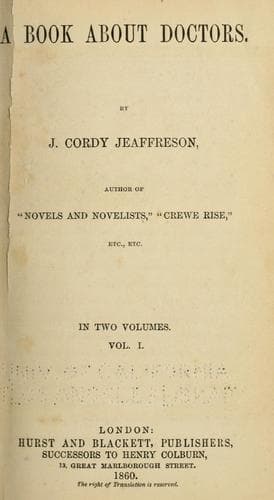
Medicine -- Anecdotes; Physicians -- Great Britain
"His Grace promised to bring into the society a piece of a unicorne's
horn.
"Sir Kenelme Digby related that the calcined powder of toades
reverberated, applyed in bagges upon the stomach of a pestiferate
body, cures it by several applications."
"_June 13._--Colonel Tuke brought in the history of rained seedes,
which were reported to have fallen downe from heaven in Warwickshire
and Shropshire, &c.
"That the dyving engine be going forward with all speed, and the
treasurer to procure the lead and moneys.
"Ordered, that Friday next the engine be tried at Deptford."
"_June 26._--Dr Ent, Dr Clarke, Dr Goddard, and Dr Whistler, were
appointed curators of the proposition made by Sir G. Talbot, to
torment a man presently with the sympatheticall powder.
"Sir G. Talbot brought in his experiments of the sympathetick cures."
It is true that these passages relate to transactions of the Royal
Society that occurred long before Sir Hans was one of the body. But
even in his time the advances made towards greater enlightenment were
few and feeble, when compared with the strides of science during the
last century. So simple and childish were the operations and
speculations of the Society in the first half of the eighteenth
century, that even Sir John Hill was able to cover them with ridicule.
Sir Hans had two medical successors in the presidentship of the Royal
Society--Sir John Pringle, Bart., elected Nov. 30, 1772, and William
Hyde Wollaston, M.D., elected June 29, 1820. The last-mentioned
physician had but a brief tenure of the dignity, for he retired from
the exalted post on Nov. 30, 1820, in favor of Sir Humphrey Davy,
Bart.
Humphrey Davy (the son of the Penzance woodcarver, who was known to
his acquaintances as "Little Carver Davy") was the most acute natural
philosopher of his generation, and at the same time about the vainest
and most eccentric of his countrymen. With all his mental energy, he
was disfigured by a moral pettiness, which, to a certain extent,
justified Wordsworth's unaccustomed bitterness in "A Poet's
Epitaph":--
"Physician art thou? one all eyes;
Philosopher? a fingering slave,
One that would peep and botanize
Upon his mother's grave!
"Wrapt closely in thy sensual fleece,
O turn aside--and take, I pray,
That he below may rest in peace,
Thy ever-dwindling soul away!"
Public-domain text, read in full here on John Shaqi.
Reviews
Reviews
No reviews yet
Be the first to share your thoughts on this work.
Join the Discussion
Join the discussion
Sign in to leave a comment or review.
Sign InorCreate an account