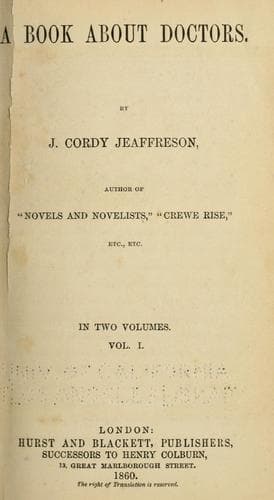
Medicine -- Anecdotes; Physicians -- Great Britain
The apothecaries to whom these excellent directions were given were
only tradesmen--grocers who paid attention to the commands of
physicians. They were not required to have any knowledge of the
medical science, beyond what might be obtained by the perusal of two
or three writers; they were not to presume to administer drugs on
their own judgment and responsibility--or to perform any surgical
operation, except phlebotomy, and that only for one malady. The custom
was for the doctors to sell their most valuable remedies as nostrums,
keeping their composition a secret to themselves, and themselves
taking the price paid for them by the sick. The commoner drugs were
vended to patients by the drug-merchants (who invariably dealt in
groceries for culinary use, as well as in medicinal simples), acting
under the directions of the learned graduates of the Faculty.
In the fourth year of James I., a charter was obtained, that "Willed,
ordained, and granted, that all and singular the Freemen of the
Mystery of Grocers and Apothecaries of the City of London ... should
and might be ... one body corporate and politique, in deed, fact, and
name, by the name of Warden and Commonalty of the Mystery of Grocers
of the City of London." But in the thirteenth year of the same king,
the apothecaries and grocers were disunited. At the advice of Theodore
de Mayerne and Henry Atkins, doctors in physick, another charter was
granted, constituting drug-venders a distinct company. Amongst the
apothecaries mentioned in this charter are the names of the most
respectable families of the country. Gideon de Laune, one of this
first batch of apothecaries, amassed a very large fortune in his
vocation, and founded a family at Sharsted, in Kent, from which
several persons of distinction draw part of their origin; and not a
few of De Laune's brethren were equally lucky.
At their first foundation as a company the apothecaries were put
completely under control of the College of Physicians, who were
endowed with dangerous powers of inspecting their wares and punishing
their malpractices. But before a generation had passed away, the
apothecaries had gained such a firm footing in society that the more
prosperous of them could afford to laugh at the censures of the
College; and before the close of a century they were fawned upon by
young physicians, and were in a position to quarrel with the old.
The doctors of that day knew so little that the apothecaries found it
easy to know as much. A knowledge of the herbals, an acquaintance with
the ingredients and doses of a hundred empirical compounds and
systems of maltreating eruptive fevers, gout, and consumption,
constituted all the medical learning of such men as Mayerne or
Gibbons. To pick up that amount of information was no hard task for an
ambitious apothecary.
Public-domain text, read in full here on John Shaqi.
Reviews
Reviews
No reviews yet
Be the first to share your thoughts on this work.
Join the Discussion
Join the discussion
Sign in to leave a comment or review.
Sign InorCreate an account