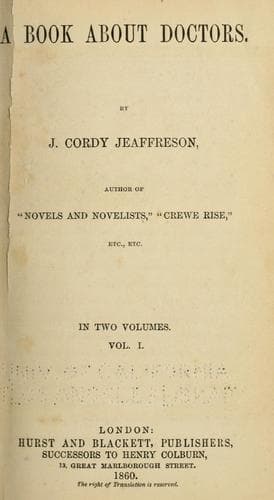
Medicine -- Anecdotes; Physicians -- Great Britain
Soon the leading apothecaries began to prescribe on their own
responsibility, without the countenance of a member of the College. If
they were threatened with censure or other punishment by a regular
physician, they retorted by discontinuing to call him in to
consultations. Jealousies soon sprang up. Starving graduates, with the
diplomas of Oxford and Cambridge and the certificates of the College
in their pockets, were embittered by having to trudge the pavements of
London, and see the mean medicine-mixers (who had scarce scholarship
enough to construe a Latin bill) dashing by in their carriages. Ere
long the heartburnings broke out in a paper warfare, as rancorous and
disreputable as any squabble embalmed in literature. The scholars
called the rich tradesmen thieves, swindlers, and unlettered
blockheads. The rich tradesmen taunted the scholars with discontent,
falsehood, and ignorance of everything except Latin and Greek.
Pope took the side of the physicians. Like Johnson, Parr, and all men
of enlightenment and sound scholarship, he had a high opinion of the
Faculty. It is indeed told of him, on questionable authority, that on
his death-bed, when he heard the bickerings of Dr. Burton and Dr.
Thompson, each accusing the other of maltreating his patient, he
levelled with his last breath an epigram at the two rivals--
"Dunces, rejoice, forgive all censures past--
The greatest dunce has killed your foe at last."
To Dr. Arbuthnot he wrote--
"Friend to my life, which did not you prolong,
The world had wanted many an idle song."
His feeble health, making his life a long disease, never allowed him
vigour and confidence enough to display ingratitude to the Faculty,
and illustrate the truth of the lines--
"God and the doctor we alike adore,
But only when in danger, not before;
The danger o'er, both are alike requited,
God is forgotten, and the doctor slighted."
His habitual tone, when speaking of the medical profession, was that
of warm admiration and affection. In the "Imitations of Horace" he
says--
"Weak though I am of limb, and short of sight,
Far from a lynx, and not a giant quite,
I'll do what Mead and Cheselden advise,
To keep these limbs, and to preserve these eyes."
It is true that he elsewhere ridicules Mead's fondness for rare books
and Sloane's passion for butterflies; but at the close of his days he
wrote in a confidential letter to a friend of the Faculty, "They are
in general the most amiable companions and the best friends, as well
as the most learned men I know."
In the protracted dissensions between the physicians and the
apothecaries Pope was a cordial supporter of the former. When he
accused, in the "Essay on Criticism," the penny-a-lining critics of
acquiring their slender knowledge of the poetic art from the poets
they assailed, he compared them to apothecaries whose scientific
information was pilfered from the prescriptions they were required to
dispense.
Public-domain text, read in full here on John Shaqi.
Reviews
Reviews
No reviews yet
Be the first to share your thoughts on this work.
Join the Discussion
Join the discussion
Sign in to leave a comment or review.
Sign InorCreate an account