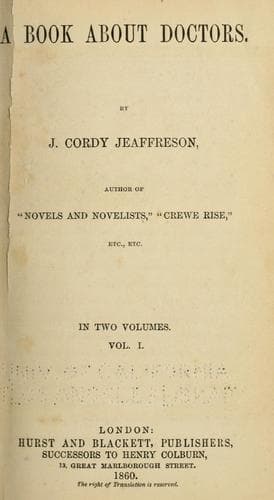
Medicine -- Anecdotes; Physicians -- Great Britain
But he lived to see the apothecaries gradually emancipate themselves
from the ignominious regulations to which they consented, when their
vocation was first separated from the grocery trade. Four years after
his death they obtained legal acknowledgment of their right to
dispense and sell medicines without the prescription of a physician;
and six years later the law again decided in their favour, with regard
to the physicians' right of examining and condemning their drugs. In
1721, Mr. Rose, an apothecary, on being prosecuted by the College for
prescribing as well as compounding medicines, carried the matter into
the House of Lords, and obtained a favourable decision. And from 1727,
in which year Mr. Goodwin, an apothecary, obtained in a court of law a
considerable sum for an illegal seizure of his wares (by Drs.
Arbuthnot, Bale, and Levit), the physicians may be said to have
discontinued to exercise their privileges of inspection.
Arbuthnot did not exceed Garth in love to the apothecaries. His
contempt for, and dislike of, the fraternity, inspired him to write
his "Essay on an Apothecary." He thinks it a pity that, to prevent the
country from being overrun with apothecaries, it should not be allowed
to anatomize them, for the improvement of natural knowledge. He
ridicules them for pedantically "dressing all their discourse in the
language of the Faculty."
"At meals," he says, "they distributed their wine with a little lymph,
dissected a widgeon, cohobated their pease-porridge, and amalgamated a
custard. A morsel of beef was a bolus; a grillard was sacrificed;
eating was mastication and deglutition; a dish of steaks was a
compound of many powerful ingredients; and a plate of soup was a very
exalted preparation. In dress, a suit of cloaths was a system, a
loophole a valve, and a surtout an integument. Cloth was a texture of
fibres spread into a drab or kersey; a small rent in it was cutaneous;
a thread was a filament; and the waistband of the breeches the
peritoneum."
The superior branch of the Faculty invited in many ways the same
satire. Indeed, pedantry was the prevalent fault of the manners of the
eighteenth century. The physician, the divine, the lawyer, the
parliament-man, the country gentleman, the author by profession--all
had peculiarities of style, costume, speech, or intonation, by which
they were well pleased they should be recognised. In one respect, this
was well; men were proud of being what they were, and desired to be
known as belonging to their respective vocations. They had no anxiety
to be free from trade-marks. The barrister's smirk, the physician's
unctuous smiles, the pedagogue's frown, did not originate in a mean
desire to be taken for something of higher mark and esteem than they
really were.
Public-domain text, read in full here on John Shaqi.
Reviews
Reviews
No reviews yet
Be the first to share your thoughts on this work.
Join the Discussion
Join the discussion
Sign in to leave a comment or review.
Sign InorCreate an account