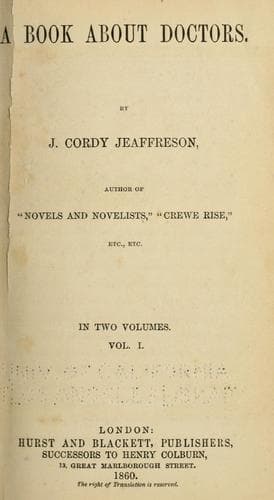
Medicine -- Anecdotes; Physicians -- Great Britain
From the time when Bulleyn called him the physician's cook, down to
the present, generation, the pure apothecary is found holding a very
subordinate position. His business is to do unpleasant drudgery that a
gentleman finds it unpleasant to perform, but which cannot be left to
the hands of a nurse. The questions to be considered previous to
becoming an apprentice to an apothecary, put in Chemberlaine's
"Tyrocinium Medicum," well describe the state of the apothecary's
pupil. "Can you bear the thoughts of being obliged to get up out of
your warm bed, on a cold winter's night, or rather morning, to make up
medicines which your employer, just arrived through frost and snow,
prescribes for a patient taken suddenly or dangerously ill?--or,
supposing that your master is not in sufficient business to keep a
boy to take out medicines, can you make up your mind to think it no
hardship to take them to the patient after you have made them up?"
&c., &c. When such services were expected from pupils studying for
admittance to the craft, of course boys with ample means, or prospects
elsewhere, did not as a rule desire to become apothecaries.
Within the last fifty years changes have been affected in various
departments of the medical profession, that have rendered the
apothecary a feature of the past, and transferred his old functions to
a new labourer. Prior to 1788, it is stated on authority there were
not in all London more than half-a-dozen druggists who dispensed
medicines from physicians' prescriptions. Before that time, the
apothecaries--the members of the Apothecaries' Company--were almost
the sole compounders and preparers of drugs. At the present time it is
exceptional for an apothecary to put up prescriptions, unless he is
acting as the family or ordinary medical attendant to the patient
prescribed for. As a young man, indeed, he sometimes condescends to
keep an open shop; but as soon as he can get on without "counter"
business, he leaves the commercial part of his occupation to the
druggist, as beneath his dignity. The dispensing chemists and
druggists, whose shops, flashing with blue bottles (last remnant of
empiric charlatanry), brighten our street corners and scare our horses
at night, are the apothecaries of the last century. The apothecary
himself--that is, the member of the Company--is hardly ever found as
an apothecary _pur et simple_. He enrolls himself at "the hall" for
the sake of being able to sue ungrateful patients for money due to
him. But in the great majority of cases he is also a Fellow or Member
of the College of Surgeons, and acts as a general practitioner; that
is, he does anything and everything--prescribes and dispenses his
prescriptions; is at the same time physician, surgeon, accoucheur, and
dentist. Physic and surgery were divided at a very early date in
theory, but in practice they were combined by eminent physicians till
a comparatively recent period. And yet later the physician performed
Public-domain text, read in full here on John Shaqi.
Reviews
Reviews
No reviews yet
Be the first to share your thoughts on this work.
Join the Discussion
Join the discussion
Sign in to leave a comment or review.
Sign InorCreate an account