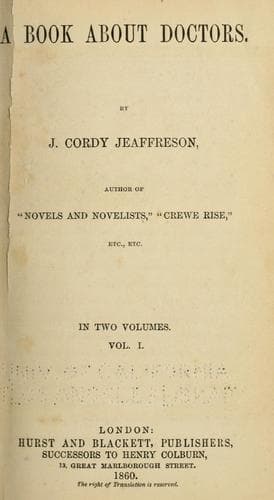
Medicine -- Anecdotes; Physicians -- Great Britain
But though the doctor, like a soldier skulking from the field of
battle, might with impunity decline visiting the wretched captives,
the judge was forced to do his part of the social duty to them--to sit
in their presence during their trial in a close, fetid court; to
brow-beat them when they presumed to make any declaration of their
innocence beyond a brief "not guilty"; to read them an energetic
homily on the consequences of giving way to corrupt passions and evil
manners; and, finally, to order them their proper apportionments of
whipping, or incarceration, or banishment, or death. Such was the
abominable condition of our prisons, that the poor creatures dragged
from them and placed in the dock often by the noxious effluvia of
their bodies made seasoned criminal lawyers turn pale--partly,
perhaps, through fear, but chiefly through physical discomfort. Then
arose the custom of sprinkling aromatic herbs before the prisoners--so
that if the health of his Lordship and the gentlemen of the long robe
suffered from the tainted atmosphere, at least their senses of smell
might be shocked as little as possible. Then, also, came the
chaplain's bouquet, with which that reverend officer was always
provided when accompanying a criminal to Tyburn. Coke used to go
circuit carrying in his hand an enormous fan furnished with a handle,
in the shape of a goodly stick--the whole forming a weapon of offence
or defence. It is not improbable that the shrewd lawyer caused the end
of this cumbrous instrument to be furnished with a vinaigrette.
So much for the head of the physician's cane. The stick itself was
doubtless a relic of the conjuring paraphernalia with which the
healer, in ignorant and superstitious times, worked upon the
imagination of the credulous. Just as the ? which the doctor affixes
to his prescription is the old astrological sign (ill-drawn) of
Jupiter, so his cane descended to him from Hermes and Mercurius. It
was a relic of old jugglery, and of yet older religion--one of those
baubles which we know well where to find, but which our conservative
tendencies disincline us to sweep away without some grave necessity.
The charming-stick, the magic Æsculapian wand of the Medicine-man,
differed in shape and significance from the pole of the
barber-surgeon. In the "British Apollo," 1703, No. 3, we read:--
"I'd know why he that selleth ale
Hangs out a chequer'd part per pale:
And why a barber at port-hole
Puts forth a parti-coloured pole?"
ANSWER.
Public-domain text, read in full here on John Shaqi.
Reviews
Reviews
No reviews yet
Be the first to share your thoughts on this work.
Join the Discussion
Join the discussion
Sign in to leave a comment or review.
Sign InorCreate an account