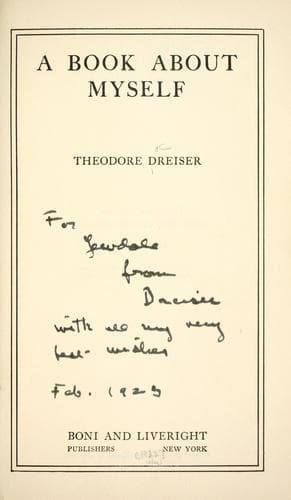
Dreiser, Theodore, 1871-1945; Journalists -- United States -- Biography; Novelists, American -- 20th century -- Biography
THINGS relatively interesting, contrasts nearly as sharp and as well
calculated to cause one to meditate on the wonder, the beauty, the
uncertainty, the indifference, the cruelty and the rank favoritism of
life, were daily if not hourly put before me. Now it would be some such
murder as this or a social scandal of some kind, often of a gross and
revolting character, in some ultra-respectable neighborhood, or a
suicide of peculiarly sad or grim character. Or, again, it would be a
fine piece of chicane, as when a certain “board-and-feed” stable owner
of the west end, about to lose his property because of poor business and
anxious to save himself by securing the insurance, set fire to the
stable and destroyed seventeen healthy horses as well as one stable
attendant and “got away with it,” legally anyhow. His plan had probably
been to save the horses and the man, but the plan miscarried. I gathered
as much from him when I interviewed him. I put some pertinent questions
at him but could get no admissions on which to base a charge. He was a
shrewd, calculating, commercial type, vigorous and semi-savage. He
evaded me blandly and I had to write the fire up as a sad accident,
thereby aiding him to get his insurance, the while I was convinced that
he was guilty, a hard-hearted scoundrel.
Another thing that I sensed very clearly at this time was the fact that
the average newspaper reporter was a far better detective in his way
than the legitimate official detective, and not nearly so well paid. The
average so-called “headquarters man,” was a loathsome thing, as low in
his ideas and methods as the lowest criminal he was set to trap. The
criminal was at least shrewd and dynamic enough to plot and execute a
crime, whereas the detective had no brains at all, merely a low kind of
cunning. Often red-headed, freckled, with big hands and feet, store
clothes, squeaky shoes—why does such a picture of the detective come
back to me? Pop-eyed, with a ridiculous air of mystery and profundity in
matters requiring neither, dirty, offensive, fish-eyed and merciless,
the detectives floundered about in different cases without a grain of
humor; whereas the average reporter was, by contrast anyhow, intelligent
or shrewd, cleanly nearly always, if at times a little slouchy, inclined
to drink and sport perhaps but genial, often gentlemanly, a fascinating
story-teller, a keen psychologist (nearly always one of the best),
frequently well read, humorous, sympathetic, amusing or gloomy as the
case might be, but generally to be relied upon in such emergencies for
truly skillful work. Naturally there was some enmity between the two, a
contempt on the part of the newspaper man for the detective, a fear and
dislike and secret opposition on the part of the detective. The reporter
would go forth on a mystifying case and as a rule, given time enough,
would solve it, whereas the police detectives would be tramping about
Public-domain text, read in full here on John Shaqi.
Reviews
Reviews
No reviews yet
Be the first to share your thoughts on this work.
Elsewhere in the archive
Join the Discussion
Join the discussion
Sign in to leave a comment or review.
Sign InorCreate an account