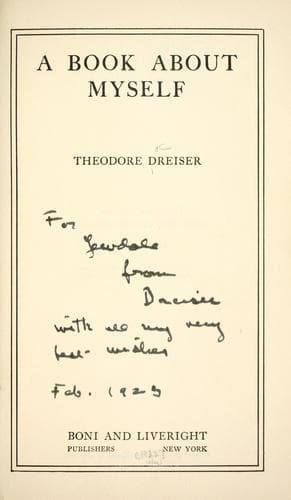
Dreiser, Theodore, 1871-1945; Journalists -- United States -- Biography; Novelists, American -- 20th century -- Biography
For the romance of my own youth was still upon me, my ambitions and my
dreams coloring it all. Does the gull sense the terrors of the deep, or
the butterfly the traps and snares of the woods and fields? Roaming this
keen, new, ambitious mid-Western city, life-hungry and love-hungry and
underpaid, eager and ambitious, I still found so much in the worst to
soothe, so much in the best to torture me. In every scene of ease or
pleasure was both a lure and a reproach; in every aspect of tragedy or
poverty was a threat or a warning. I was never tired of looking at the
hot, hungry, weary slums, any more than I was of looking at the glories
of the mansions of the west end. Both had their lure, their charm; one
because it was a state worse than my own, the other because it was a
better—unfairly so, I thought. Amid it all I hurried, writing and
dreaming, half-laughing and half-crying, with now a tale to move me to
laughter and now another to send me to bottomless despairs. But always
youth, youth, and the crash of the presses in the basement and a fresh
damp paper laid on my desk of a morning with “the news” and my own petty
achievements or failures to cheer or disappoint me; so it went, day in
and day out.
The _Republic_, while not so successful as the _Globe-Democrat_, was a
much better paper for me to work on. For one thing, it took me from
under the domination of Mr. Mitchell (one can hate some people most
persistently), and placed me under one who, whatever may have been his
defects, provided me with far greater opportunities for my pen than ever
the _Globe_ had and supplied a better judgment as to what constituted a
story and a news feature. Now that I think of him, Wandell was far and
away the best judge of news, from a dramatic or story point of view, of
any for whom I ever worked.
“A good story, is it?” I can see him smirking and rubbing his hands
miser or gourmet fashion, as over a pot of gold or a fine dish. “She
said that, did she? Ha! ha! That’s excellent, excellent! You saw him
yourself, did you? And the brother too? By George, we’ll make a story of
that! Be careful how you write that now. All the facts you know, just as
far as they will carry you; but we don’t want any libel suits, remember.
We don’t want you to say anything we can’t substantiate, but I don’t
want you to be afraid either. Write it strong, clear, definite. Get in
all the touches of local color you can. And remember Zola and Balzac, my
boy, remember Zola and Balzac. Bare facts are what are needed in cases
like this, with lots of color as to the scenery or atmosphere, the room,
the other people, the street, and all that. You get me?”
Public-domain text, read in full here on John Shaqi.
Reviews
Reviews
No reviews yet
Be the first to share your thoughts on this work.
Elsewhere in the archive
Join the Discussion
Join the discussion
Sign in to leave a comment or review.
Sign InorCreate an account