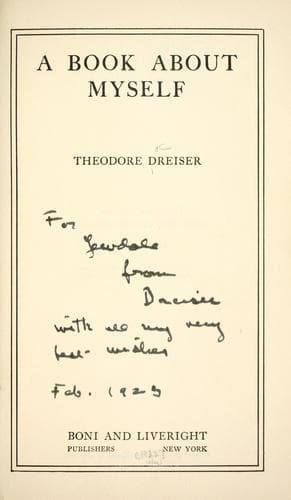
Dreiser, Theodore, 1871-1945; Journalists -- United States -- Biography; Novelists, American -- 20th century -- Biography
There was an old fat Irish sergeant of about fifty or fifty-five, James
King by name, who used to amuse me greatly. He ruled here like a
potentate under the captain, whom I rarely saw. The latter had an office
to himself in the front of the station and rarely came out, seeming
always to be busy with bigwigs of one type and another. With the
sergeant, however, I became great friends. His place was behind the
central desk, in the front of which were two light standards and on the
surface of which were his blotter and reports of different kinds. Behind
the desk was his big tilted swivel chair, with himself in it, stout,
perspiring, coatless, vestless, collarless, his round head and fat neck
beady with sweat, his fat arms and hands moist and laid heavily over his
protuberant stomach. According to him, he had been at this work exactly
eight years, and before that he had “beat the sidewalk,” as he said, or
traveled a beat.
“Yes, yes, ‘tis a waarm avenin’,” he would begin whenever I arrived and
he was not busy, which usually he was not, “an’ there’s naathin’ for ye,
me lad. But ye might just as well take a chair an’ make yerself
comfortable. It may be that something will happen, an’ again maybe it
won’t. Ye must hope fer the best, as the sayin’ is. ’Tis a bad time fer
any trouble to be breakin’ out though, in all this hot weather,” and
then he would elevate a large palmleaf fan which he kept near and begin
to fan himself, or swig copiously from a pitcher of ice-water.
Here then he would sit, answering telephone calls from headquarters or
marking down reports from the men on their beats or answering the
complaints of people who came in hour after hour to announce that they
had been robbed or their homes had been broken into or that some
neighbor was making a nuisance of himself or their wives or husbands or
sons or daughters wouldn’t obey them or stay in at night.
“Yes, an’ what’s the matter now?” he would begin when one of these would
put in an appearance.
Perhaps it was a man who would be complaining that his wife or daughter
would not stay in at night, or a woman complaining so of her husband,
son or daughter.
“Well, me good woman, I can’t be helpin’ ye with that. This is no court
av laaw. If yer husband don’t support ye, er yer son don’t come in av
nights an’ he’s a minor, ye can get an order from the judge at the Four
Courts compellin’ him. Then if he don’t mind ye and ye waant him
arrested er locked up, I can help ye that way, but not otherwise. Go to
the Four Courts.”
Sometimes, in the case of a parent complaining of a daughter’s or son’s
disobedience, he would relent a little and say: “See if ye can bring him
around here. Tell him that the captain waants to see him. Then if he
comes I’ll see what I can do fer ye. Maybe I can scare him a bit.”
Public-domain text, read in full here on John Shaqi.
Reviews
Reviews
No reviews yet
Be the first to share your thoughts on this work.
Elsewhere in the archive
Join the Discussion
Join the discussion
Sign in to leave a comment or review.
Sign InorCreate an account